

How can digital health applications support people with cancer in their everyday lives? And what do affected individuals and their relatives really need for such tools to be helpful, understandable and easy to use?
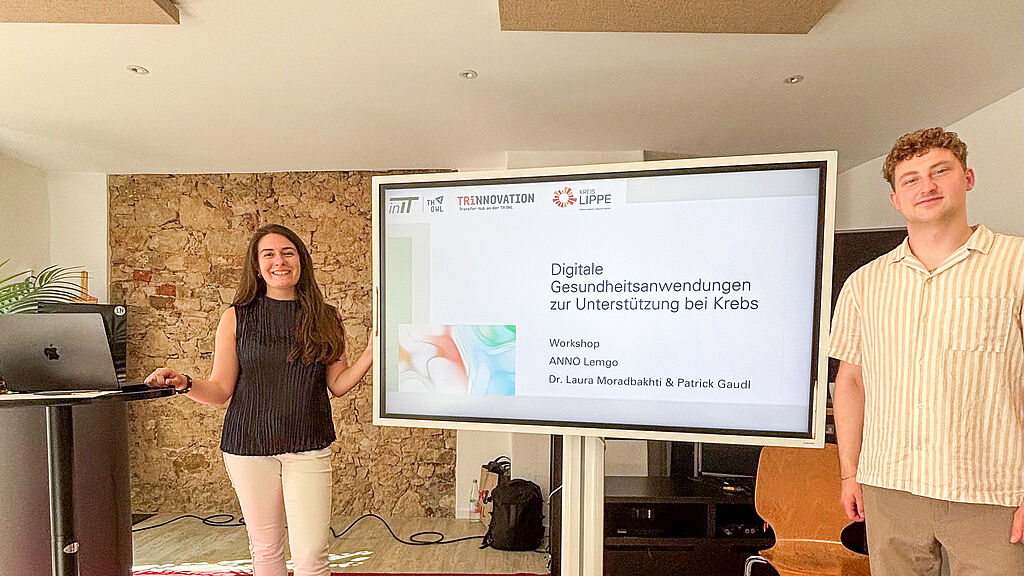
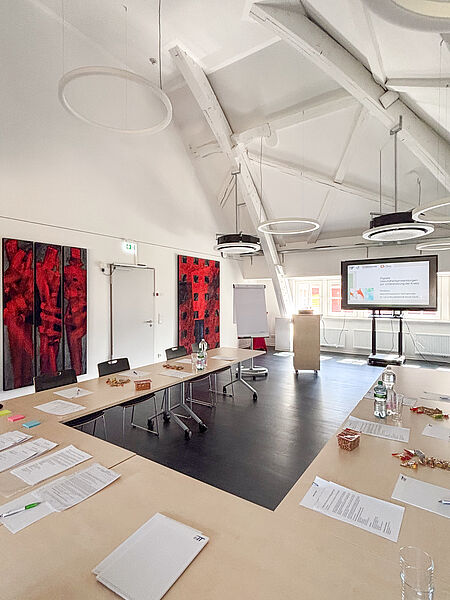
These questions were at the heart of a three-part workshop series by Dr. Laura Moradbakhti on “Digital apps to support cancer patients and their relatives”. Together with her research associate Patrick Gaudl, she conducted the free workshops at the Oerlinghausen Health Center and at ANNO 1578 in Lemgo’s city centre. The series attracted strong interest.
What are DiGAs?
Digital health applications, or DiGAs for short, are approved medical apps or browser-based applications that can support people in the detection, monitoring, treatment or alleviation of diseases. For example, they can help document symptoms, present information in an understandable way, guide exercises or support people in managing a disease in everyday life.
However, technical availability alone is not enough for such applications to create real added value. It is also crucial that people affected by disease are sufficiently informed about these offers, understand them, can use them with low barriers and feel well supported in managing their condition.
Inform, try out, discuss
At the beginning of the workshops, the focus was on providing orientation: Which applications are already available for people with cancer? How can they support everyday life? And what options are there for accessing these offers?
The next focus was on hands-on exploration. Using provided test devices and test accounts, the participants were able to try out various applications directly. The joint discussion also addressed experiences, open questions, areas for improvement and wishes for future digital support services.
The open exchange was particularly valuable: affected individuals and relatives shared their own experiences, questions and perspectives. This made clear how diverse expectations of digital support can be – and how important it is to take this diversity into account in research and development from the outset.
“Digital health applications can only provide meaningful support if they are not developed past the needs of the people they are meant to help. Direct exchange with affected individuals and relatives shows us which functions are useful in everyday life, where uncertainties remain and which digital offers or accompanying training formats will be needed in the future,” says Dr. Laura Moradbakhti.
Many thanks to all participants for their great interest, openness and valuable exchange!
Research at the intersection of AI, digital health and human-technology interaction
As part of the TH OWL PROFuture funding programme, Dr. Laura Moradbakhti is establishing a research group at inIT on “AI and Digital Assistance Systems in Healthcare”. In cooperation with the Public Health Office of the District of Lippe, she is conducting research as a tandem postdoc on artificial intelligence for digital assistance systems designed to strengthen health literacy among the population.
With her experience in digital health, UX research, human-technology interaction, technology acceptance, AI ethics and social robotics, she brings exactly the perspective that is essential for digital health solutions: technology must be developed in a scientifically sound, ethically responsible way and closely aligned with people’s needs.
Auther: Mona Marie Brinkmann