

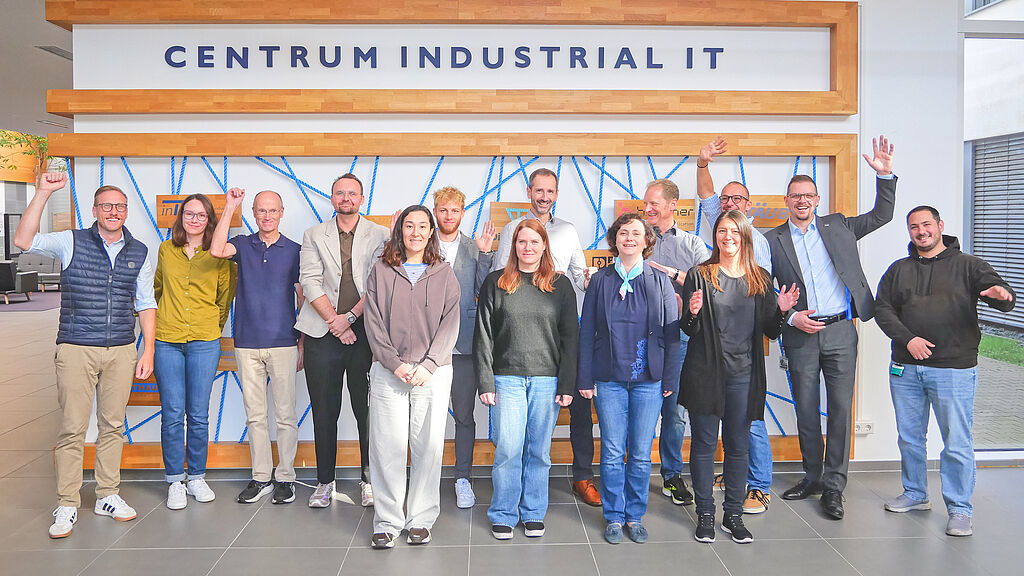
How can a conventional data sheet be transformed into a Digital Product Passport (DPP) that presents relevant product information in a clear and transparent way? This was the central question of a workshop held as part of the GoProZeroproject, organised by inIT together with Fraunhofer IOSB-INA. Jonas Kortner (Fraunhofer IOSB-INA) and Philip Sehr, research associate in the Interconnected Automation Systems research group at inIT, headed by Prof. Dr. Henning Trsek, led the workshop and guided participants from various companies through a day combining exchange, discussion and practical implementation.
AAS and DPP in Practice
The day began with coffee, giving participants an opportunity to get to know one another and engage in in-depth discussions. Right at the CinITo coffee bar, participants were able to see how a DPP based on the Asset Administration Shell (AAS) can be implemented in practice. The AAS structures the relevant product information, while the DPP makes this information visible and accessible. This sparked interest – and at the same time prompted an engaged discussion: Is the required data not already available? Does the DPP create additional bureaucracy, or does it offer genuine added value?
The discussion highlighted a key point: Many relevant pieces of information already exist within companies, but they are often distributed across different systems and formats. The Asset Administration Shell can structure and consolidate this data and make it available for different use cases.
“The Digital Product Passport does not necessarily mean that companies need to build up new mountains of data. Much of the information already exists. With the AAS, it can be brought together in a structured way and made usable for different applications,” explains Philip Sehr. This creates a basis for sharing product information in a structured manner and improving traceability along the value chain
From Concept to a Custom AAS
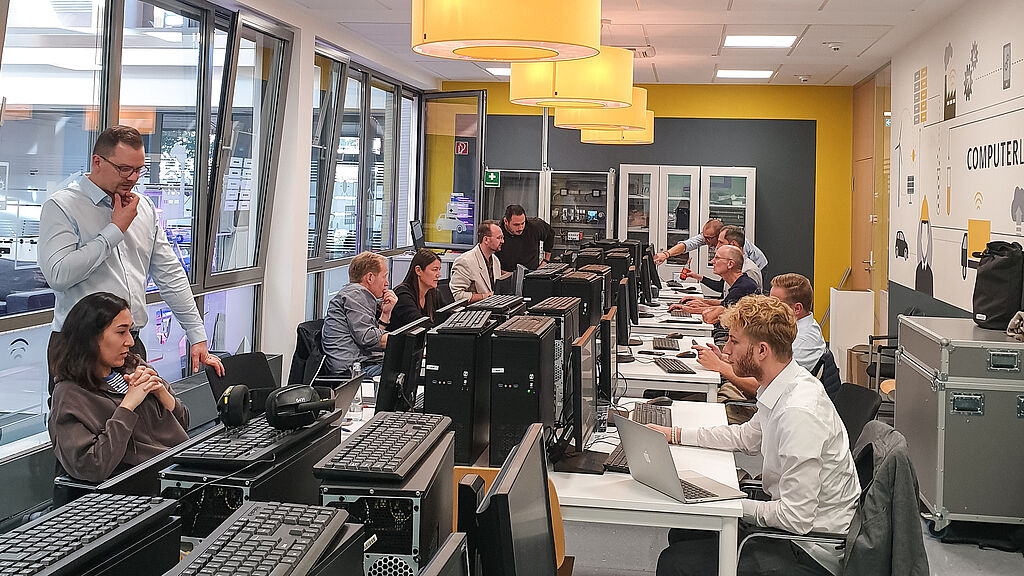
After the introduction to DPP and AAS, the focus shifted directly to practical application. In the inIT ComputerLab, participants became active themselves. They hosted their own AAS server, created type shells and entered the required product data. They were then able to see how a Digital Product Passport can be derived and displayed based on the information stored in the AAS.
Throughout the afternoon, participants tested approaches, discussed ideas and worked together on solutions. The workshop showed that AAS is not an abstract technology of the future, but a practical tool that can already be used today. The DPP makes the structured product information usable and visible for the respective application.
Exchange Across Different Industries
The feedback was positive: Many participants now feel better prepared to further advance the implementation of a DPP within their own companies.
The exchange between the participating companies also proved to be highly valuable. Participants contributed perspectives from connectivity and automation technology, digitalisation, agricultural technology, mattress manufacturing, software development, as well as data and verification infrastructures for raw materials. This broad range of experience and expertise provided new impulses and enabled valuable knowledge transfer.
One participant summed up the value of the practical work: “The practical exercise answered many open questions. I can now better assess which data is already available and how it can be structured for a Digital Product Passport using the Asset Administration Shell.”
Further workshops are planned to build on this exchange and continue the shared journey from data sheet to Digital Product Passport.
Further information about the GoProZero project:
Auther: Mona Marie Brinkmann