

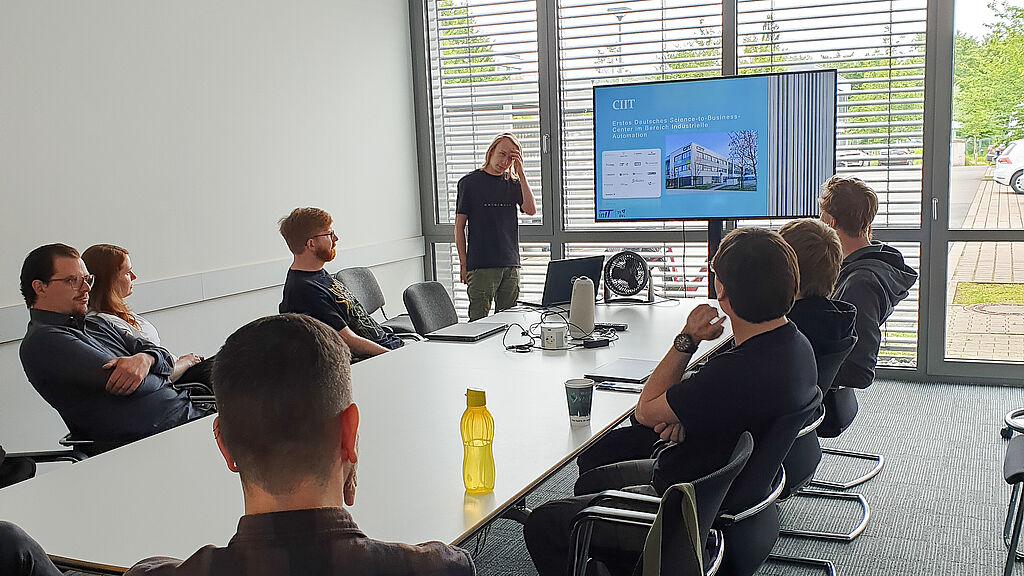
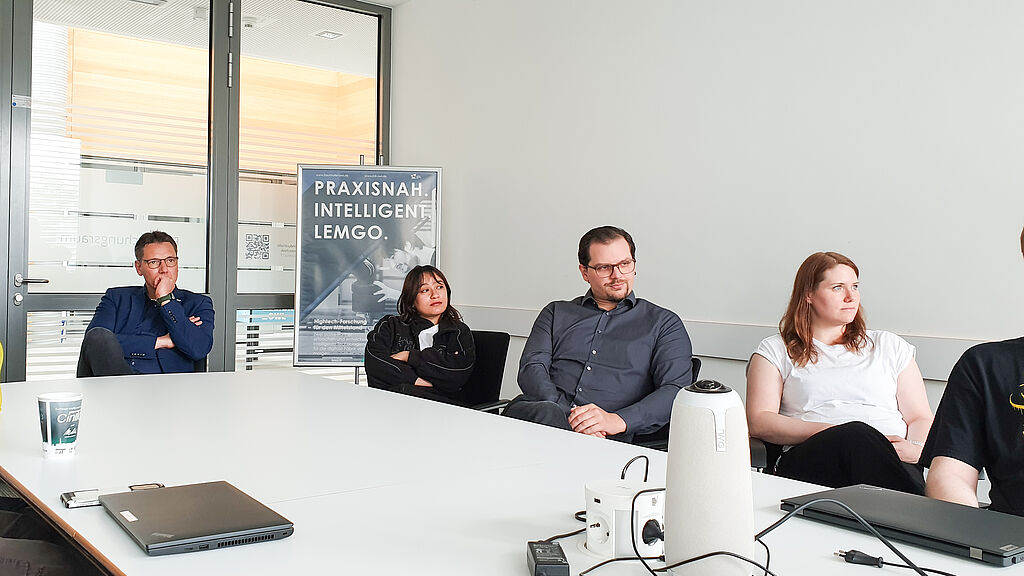
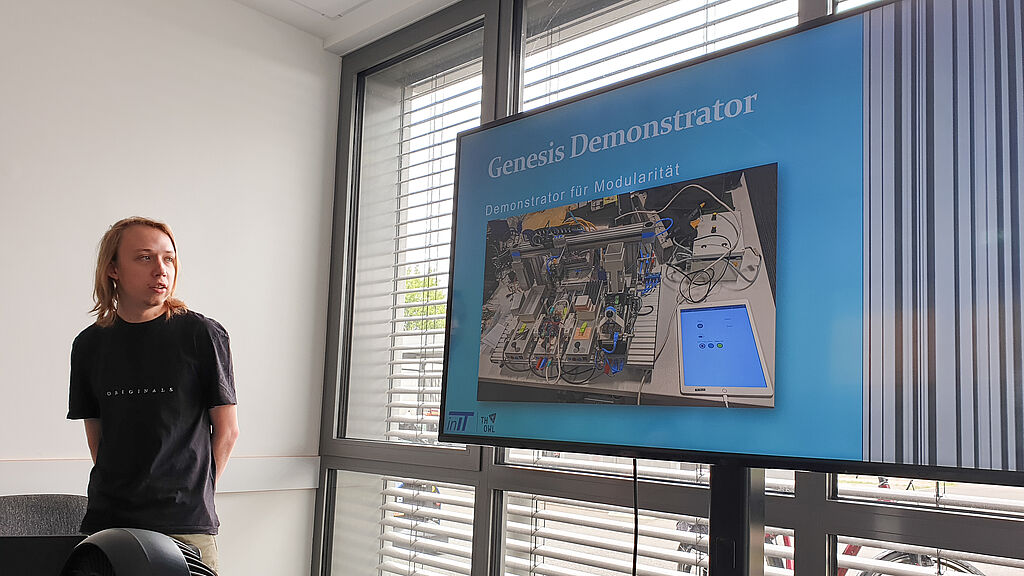
Marlon Marx, a student at Lüttfeld Berufskolleg, completed a six-week internship in the “Interconnected Automation Systems” research group led by Prof. Dr. Henning Trsek. During his time at inIT, he gained insights into everyday research, worked on a demonstrator and presented his results to the research group at the end of his internship.
In the interview, he talks about what he worked on at inIT and what he takes away from the experience.
Interview with Marlon Marx
Marlon, you are a student at Lüttfeld Berufskolleg. What are you currently doing there?
I am training to become an information technology assistant while also completing my university of applied sciences entrance qualification. For my internship, I wanted to work in an area where I could apply and deepen technical topics in a practical way. That is why I was very pleased to have this opportunity at inIT.
How did you find out about the internship at inIT?
Because of its proximity to the Innovation Campus Lemgo, I already knew the university and the campus a little. The contact with inIT then came about through the network on campus. In terms of content, it was a very good fit for me, and I am glad that I was able to work in the Networked Automation Systems research group and gain insights into research.
What exactly did you work on?
I worked on a demonstrator and ported it to a new communication standard, OPC UA. The demonstrator shows how modularity can work in automated systems: it consists of individual modules that can be removed and freely exchanged. Using sensors, the system recognizes at which station a module is located and can then determine where to pick up components from and where to transport them.
What did you find particularly exciting?
What I found particularly exciting was that I was not just able to observe, but could really get involved in practical work. This gave me a much better understanding of how complex such systems are – and how much coordination between hardware, software and communication is involved.
How did you experience working in the research group?
The research group was great. I was warmly welcomed and had Niels as a fixed contact person I could turn to at any time. The rest of the team also supported me a lot. What I particularly appreciated was the trust they placed in me and the fact that I was able to work on tasks independently.
What do you take away from the internship?
What I take away above all is how varied the work in a research group can be. It was exciting to see the topics the team works on and how many different tasks come together – from technical questions and practical implementation to exchange within the group. I really enjoyed that, and it has encouraged me to continue in this direction in the future.
What are your plans after completing your university of applied sciences entrance qualification?
After completing my university of applied sciences entrance qualification, I would like to do a dual study programme. The internship helped me gain a better impression of what technical topics can look like later on in practice and in research. This has further strengthened my wish to continue in this direction.
Insights for the next step
For Marlon, the internship was an opportunity to explore technical topics not only in theory, but directly in a research environment. We are pleased that he was able to gain these insights at inIT, and wish him all the best and every success for his future path – especially with a view to his planned dual study programme.
Auther: Mona Marie Brinkmann