

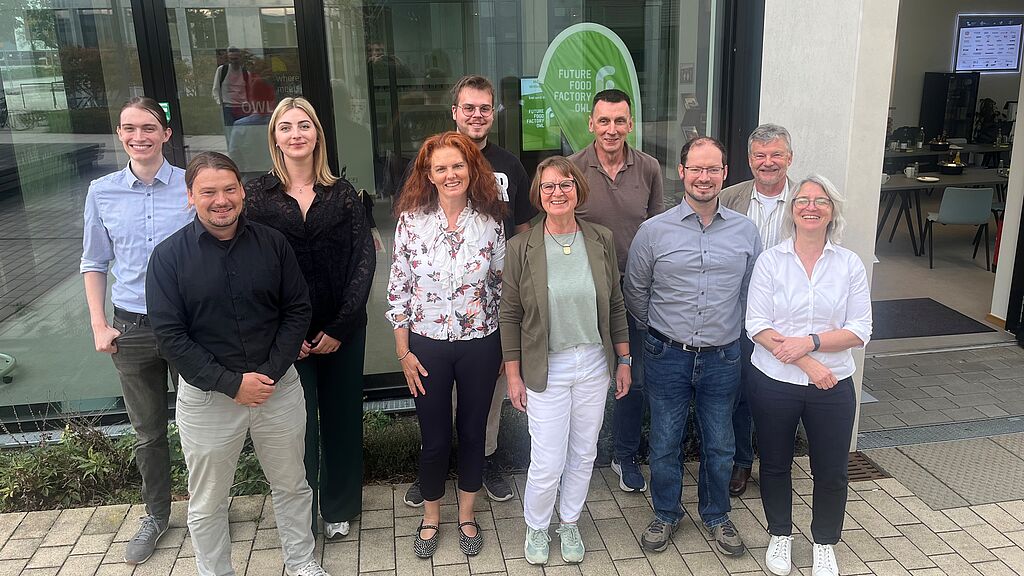
On 30 September 2026, the project partners met at the Innovation Campus Lemgo to mark the conclusion of the Mini6Ei project. This brought to an end around three years of joint research. Reason enough for inIT research associate Jens Staufenbiel from the Mathematics and Authentication working group, led by Prof. Dr. Helene Dörksen, to look back on the work they had accomplished together with the partners.
The Mini6Ei project
The full title of the project was: “Mini6Ei: Minimally invasive sex determination in six-day-old hatching eggs using time-resolved fluorescence spectroscopy.” The focus was on the development and practical validation of a minimally invasive method for determining the sex of chicken eggs as early as the sixth day of incubation, as reflected in the short title Mini6Ei. The overarching aim was to contribute to improved animal welfare, a highly topical social issue.
Project partners
The project was characterised by the collaboration of several research and industry partners, each contributing very different areas of expertise:
Institute Industrial IT (inIT) and Institute for Life Science Technologies (ILT.NRW), both at Technische Hochschule OWL
inIT and ILT.NRW combined their expertise in the fields of data analysis, machine learning, sensor technology, measurement technology and food/biotechnology.
Agri Advanced Technologies GmbH
The focus here was on the practical implementation and development of suitable technical concepts.
Centre for Biotechnology (CeBiTec), Bielefeld University
Biological expertise and the analysis of sex-specific characteristics laid important foundations for validation.
Institute of Chemistry – Optical Sensing and Spectroscopy at the University of Potsdam (UPOSS)
Expertise in optical sensor technology and spectroscopy formed another key component of the project.
Progress made
Significant progress was made as part of the project. This included the optimisation and standardisation of optical measurement systems, as well as the detection of fluorescence signals through the intact eggshell. Furthermore, sex-specific protein and metabolite markers were identified, and promising approaches to improving classification accuracy were developed.
A collaborative approach
From Jens Staufenbiel’s perspective, the interplay between the various disciplines of biology, optics, information technology and industrial application formed the backbone of Mini6Ei. He was particularly impressed by the spirit of trust and cooperation: “A heartfelt thank you to all my project colleagues for their dedicated collaboration, the scientific exchange and the many steps we have taken together on the journey from research to practical application!”
Mini6Ei was funded by the Federal Ministry of Agriculture, Food and Home Affairs (BMLEH).