

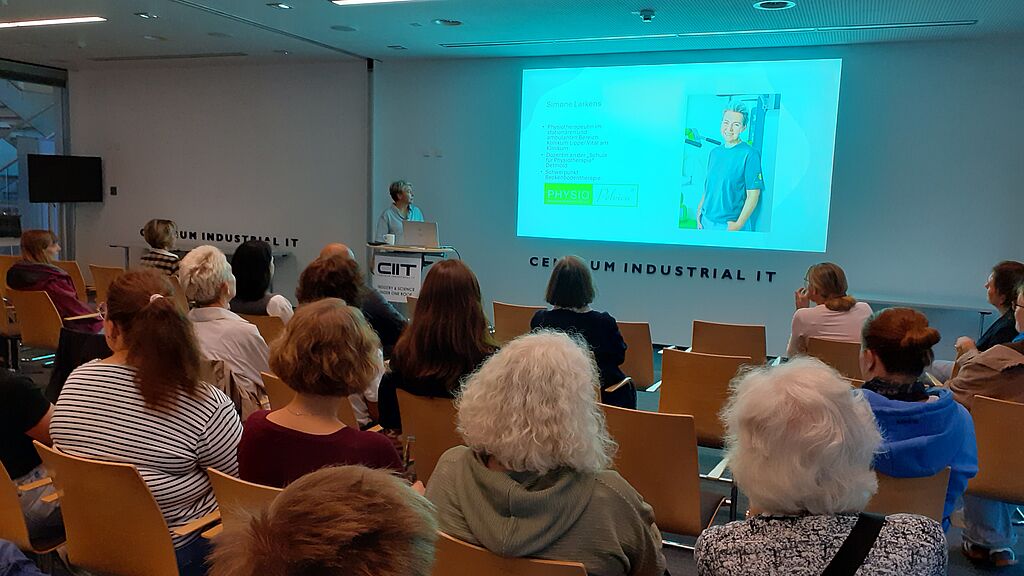
On 16 September 2026, the Parkinson’s Network East Westphalia-Lippe+ (PNOWL+) met once again at the CENTRUM INDUSTRIAL IT (CIIT). The members of PNOWL+ regularly discuss how treatment for people with Parkinson’s disease can be improved. The Discrete Systems working group, led by Senior Professor Dr. Volker Lohweg, plays an active role in organising the network meetings.
Welcome address by Prof. Dr. Christoph Redecker
Project leader Prof. Dr. Christoph Redecker, Head of the Department of Neurology and Neurogeriatrics at OWL University Hospital, brought the approximately 60 participants at the 14th network meeting up to date in his opening address.
Presentation and case conference
Following a presentation by Dr. Ingmar Wellach entitled “Therapeutic safety in Parkinson’s disease – caution in clinical and practical settings” and a case conference led by Yaman Yousef, speech and language therapist Maren George illustrated how a comprehensive treatment programme for Parkinson’s disease can be structured from a physiotherapy and speech and language therapy perspective. It is precisely this practical relevance that is highly valued by the participants.
In-depth discussion
A key feature of the network meetings’ pragmatic approach is the regular exchange within working groups. To this end, participants met in the following working groups:
Status of the PD Assist app
Pelvic floor training for Parkinson’s disease
Therapeutic safety in Parkinson’s disease
The Discrete Systems working group is developing the PD Assist app for Parkinson’s disease in collaboration with Lippe Hospital, which is designed to support both healthcare professionals and those affected by the condition. In the “App development” working group, Patrick Gaudl presented a prototype of the AI-based chatbot for the PD Assist app. Participants in the working group tried out the chatbot and provided immediate feedback. Through this exchange, the prototype’s potential and limitations were identified.
As the app is now entering the testing phase, the network meetings are of the utmost importance to Patrick Gaudl. He emphasises: “I personally benefit from both the technical and practical exchange, as this is essential for developing an app for people with Parkinson’s. The exchange with people from various disciplines, as well as with those affected, enables me, from a developer’s perspective, to truly understand the target groups and their needs.”
Plenary session and outlook
Following a concluding presentation from the working groups, Prof. Redecker highlighted the online event in November and gave a brief preview of the in-person network meetings in 2027.