


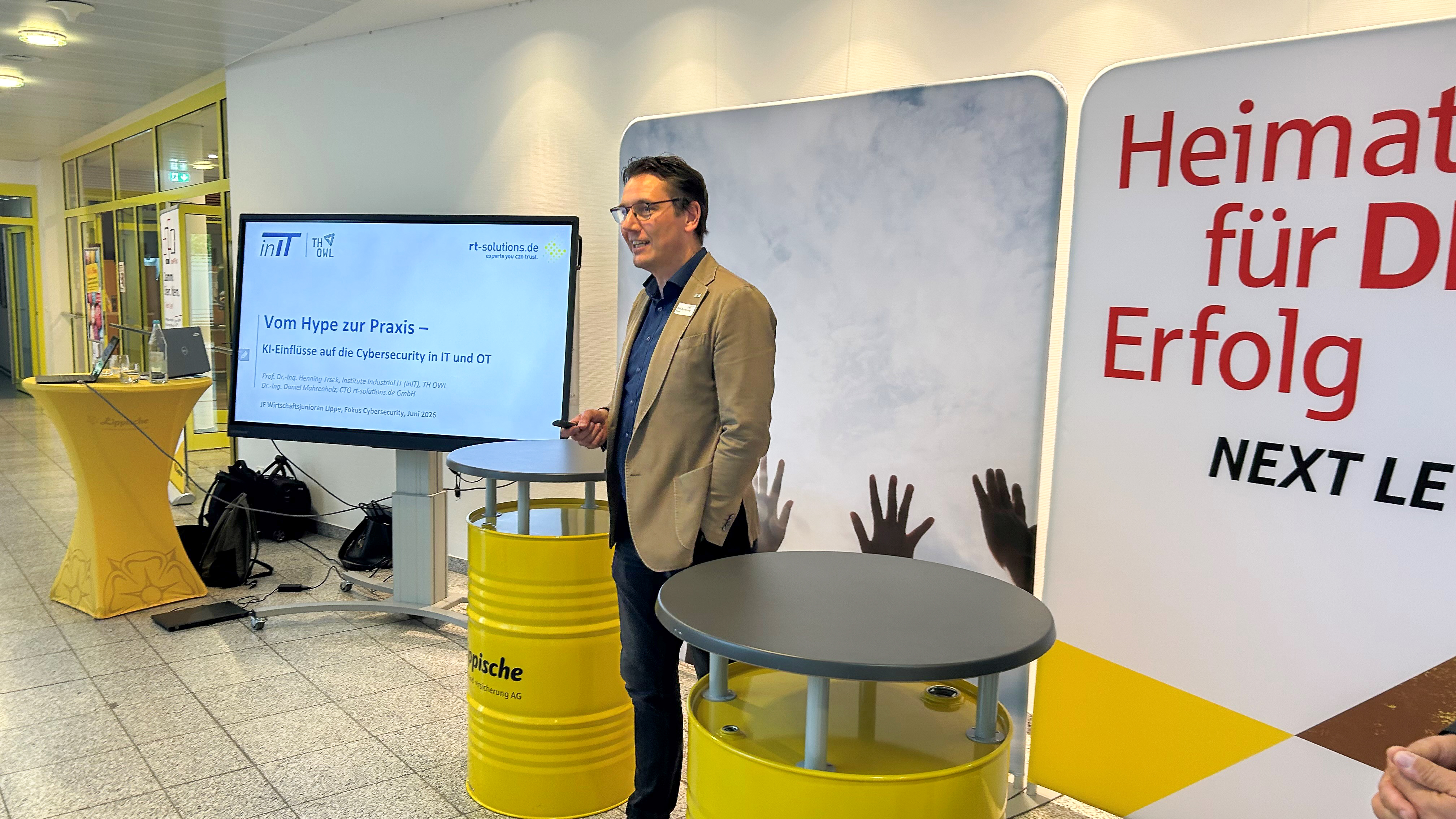

Prof. Dr. Henning Trsek gives the Wirtschaftsjunioren Lippe insights into current threats and risks in the field of cybersecurity.
How quickly can a cyberattack hit a company? What role does artificial intelligence play? And what needs to be done when a theoretical risk suddenly becomes a real emergency? These questions were at the centre of a Jour Fixe hosted by the Wirtschaftsjunioren Lippe at Lippische Landesbrandversicherung AG.
The evening opened with an impulse talk by Prof. Dr. Henning Trsek, Director of inIT and expert in cybersecurity. In his talk, he showed how AI is changing the dynamics of cyberattacks: it can make attacks more automated, more targeted and harder to detect. At the same time, it opens up new opportunities to identify anomalies in systems more quickly, assess incidents and support security processes.
When theory becomes reality
The following practical perspective on the cyberattack on Stadtwerke Detmold in November 2025 showed just how tangible such risks can become. The case made clear what consequences an attack on digital infrastructures can have: communication channels were temporarily disrupted, while technical analysis, internal coordination, crisis management and external communication all had to be handled at the same time.
The incident was also covered by WDR, which contextualised it with, among other things, an expert assessment by Prof. Dr. Henning Trsek: https://www1.wdr.de/nrw/ostwestfalen-lippe/kreis-lippe/Hackerangriff-Stadtwerke-Detmold-100.html
“Cyberattacks are no longer an abstract scenario, but a real threat to companies, public institutions and critical infrastructures. The question is no longer whether an organisation will be affected, but when. In an emergency, it is therefore crucial to remain capable of acting quickly, in a structured way and transparently,” emphasises Prof. Dr. Henning Trsek.
Taking action when an emergency occurs
To conclude the evening, Arnd Begemann from the Lippe District Police Authority assessed the current threat landscape from a policing perspective. The cybercrime specialist, who works closely with the State Criminal Police Office of North Rhine-Westphalia, provided insights into investigation and response processes in the event of cyberattacks and outlined the steps companies should take in an emergency.
One thing became clear: cyber resilience does not begin in the moment of crisis. Clear emergency protocols, trained teams, defined communication channels and early cooperation with the responsible authorities are key prerequisites for remaining capable of acting in an emergency.
Auther: Mona Marie Brinkmann