

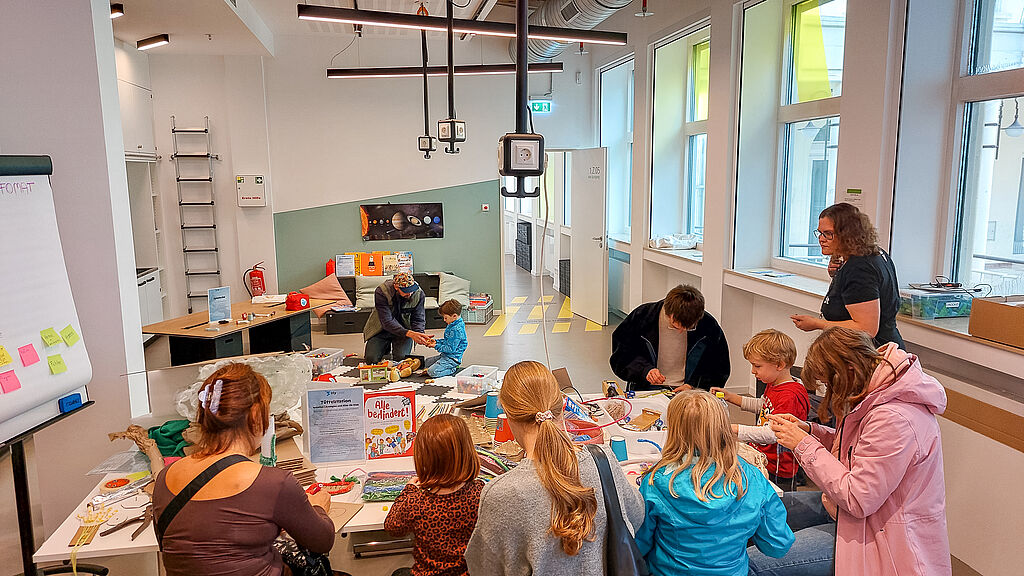

What does it feel like when your vision is impaired, your hands are trembling, or communication has to work without spoken words? And what should support look like so that it truly fits into everyday life? Children and adults explored these questions at GENIALE 2026 in the Wissenswerkstadt Bielefeld.
Also taking part was the ISyCARE Innovation Community with its interactive workshop “Kids Designing for Kids.” Together with the ISyCARE operational team, Frauke Wiegräbe, research associate in the Discrete Systems research group headed by Dr. Christoph-Alexander Holst and Dr. Laura Moradbakthi, planned and implemented the workshop.
This year’s GENIALE is dedicated to physical and mental health under the motto “Wie geht’s uns?” (“How are we doing?”), with workshops, exhibitions and interactive formats. ISyCARE brings together stakeholders from science, practice and society to jointly develop solutions for rehabilitation, care and healthcare. A central principle is that new support solutions should be closely aligned with the needs of the people who will ultimately use them.
Trying things out, changing perspectives and getting creative
At various stations, visitors were able to experience different challenges first-hand. A wheelchair course provided by PVM invited participants to try out different surfaces and typical everyday situations in a wheelchair. Simulation glasses demonstrated visual impairments such as cataracts, while special pens imitated hand tremors. Blind football and navigating a course with a white cane also offered new perspectives.
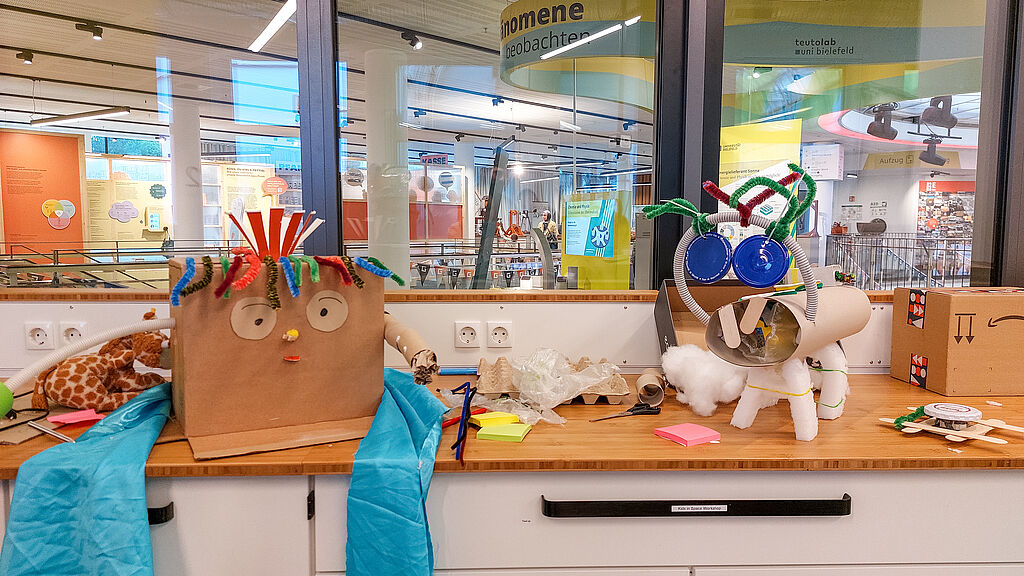
Creativity was at the heart of building the “Helfomat”. Guided by the question “What should support in everyday life look like for you?”, the children developed their own ideas and turned them into creative prototypes. Their individual needs and wishes were at the centre of the process.
“It was important to us that the children not only experienced what certain limitations can feel like in everyday life, but also asked themselves: What would actually help me in this situation? That is often where very creative ideas and entirely new perspectives emerge,” says Frauke Wiegräbe.
Strong interest and plenty of curiosity
The workshop attracted a great deal of interest. It was not only children who tried out the different stations – many adults also took the opportunity to experience the challenges themselves and gain new perspectives.
In this way, “Kids Designing for Kids” reflected a central principle of ISyCARE: solutions for people who need support should not be developed without considering their needs, but together with them. By bringing together people with lived experience, science and practice, ISyCARE aims to develop technical and social innovations that support greater independence and participation in everyday life.