

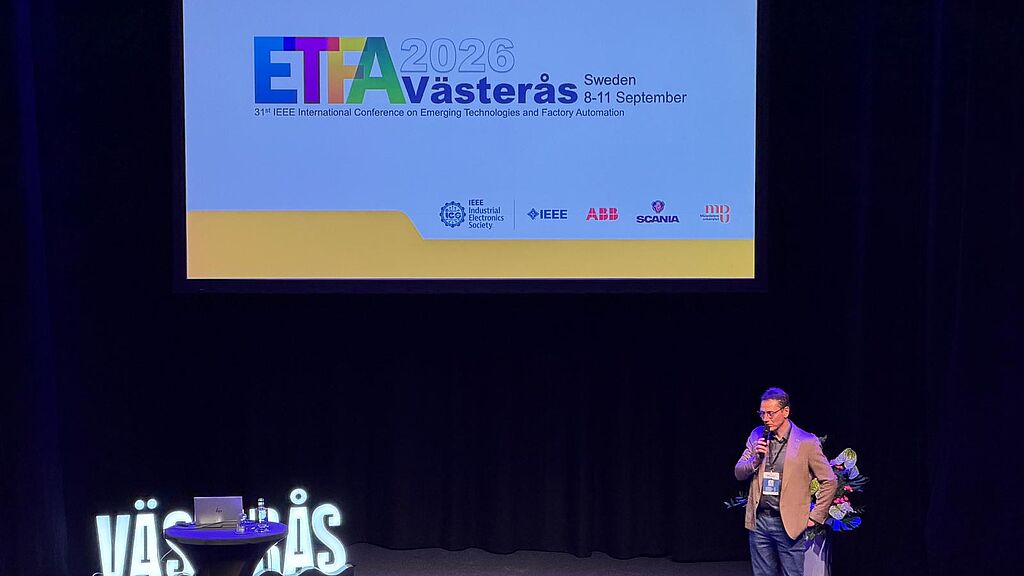
With twelve accepted research papers and the chairing of several technical sessions, the inIT at Technische Hochschule OWL and the Fraunhofer IOSB-INA were represented at the 31st IEEE International Conference on Emerging Technologies and Factory Automation (ETFA). The conference took place from 8 to 11 September 2026 in Västerås, Sweden, and brought together international experts from academia and industry. The researchers from Lemgo presented the latest findings on Artificial Intelligence (AI) in manufacturing, industrial communication and new approaches to dealing with limited data sets.
inIT contributions: AI and data-driven methods for industry
AI-assisted product search: Nico Baumgart presented a research paper, developed in collaboration with Prof. Dr. Markus Lange-Hegermann and Jan Henze (Phoenix Contact), which combines large language models with the ECLASS classification standard. The aim is to improve the search for electronic components in industrial product catalogues.
- Read the paper: https://arxiv.org/abs/2604.19664
Data-driven process optimisation: How can the condition of tools in steel spring production be reliably predicted? Julian Bültemeier addressed this question. He presented a research paper, produced in collaboration with Jan Ehlenbröker, Dr. Christoph-Alexander Holst and Sen.-Prof. Dr Volker Lohweg, on the data-driven analysis and prediction of tool condition using geometric process data.
- About the project: https://www.init-owl.de/forschung/projekte/detail/ki-gestuetzte-prozessoptimierung-fuer-nachhaltige-stahlfederproduktion/
Intelligent wireless communication: Dr. Mohsen Kazemian presented research on the use of large language models for predicting wireless channels. Together with Prof. Dr. Jürgen Jasperneite, he is investigating the potential and limitations of these models for future communication systems.
- Read the paper: https://arxiv.org/abs/2604.04028
Engineering Data Spaces: Philip Sehr presented a work-in-progress paper from the it’s OWL project GoProZero. The paper, co-authored with Jonas Kortner, Natalia Moriz, Christian Wittenbröker, Mohamed Bassam Kassabji and Prof. Dr. Henning Trsek, presents a concept for the representation and analysis of engineering data spaces in organisations.
Configuration of 5G networks: Steffen Fricke presented a work in progress paper produced as part of his PhD research. It describes a concept and an initial evaluation of a pipeline that uses AI – based on local LLMs and retrieval-augmented generation – to configure 5G networks. The work was carried out in collaboration with Prof. Jürgen Jasperneite and Prof. Jie Wang from Stanford University.
Steffen Fricke also presented a paper by Krithiga Ramesh, which was produced in collaboration with Vamsi Kumar Yerrasani. The paper, entitled “Mixed Reality Assisted Commissioning and Readiness Validation for Deterministic TSN Networks”, deals with the integration of a mixed-reality device (HoloLens). As part of the Plug-5G project, it was integrated into the existing ORCA-CNC infrastructure, resulting in a successful preliminary working prototype.
Specialist sessions on AI, data scarcity and cyber security
In addition to its own research contributions, inIT also played an active role in shaping the conference’s scientific programme. Prof. Dr. Lukasz Wisniewski, together with Dr. Stefano Scanzio from the Politecnico di Torino, was once again responsible for Track 10, “Artificial Intelligence for Cyber-Physical Systems in Automation”, which was chaired at the conference by Sen.-Professor Dr. Volker Lohweg together with Prof. Dr. Gianluca Cena (Politecnico di Torino). The five papers presented focused in particular on the use of large language models in industrial production and automation.
Together with Dr. Christoph-Alexander Holst, Rui Pinto (Universidade do Porto) and Pedro Torres (Instituto Politécnico de Castelo Branco), Sen.-Prof. Dr. Volker Lohweg also organised the special session “Addressing Data Scarcity: Machine Learning, Information Fusion, and Sustainable AI”. The five presentations focused on methods for dealing with limited amounts of data, including data-efficient algorithms, data augmentation, transfer learning and information fusion. None of the works relied on large language models.
Dr. Christoph-Alexander Holst also co-chaired the session “Industrial Cybersecurity, Threat Detection, and Vulnerability Analysis” together with Alexander Diedrich (Helmut Schmidt University). The five presentations dealt with the detection of cyber-attacks and the assessment of security vulnerabilities. These included a research paper by Felix Specht (Fraunhofer IOSB-INA) and Prof. Dr. Henning Trsek on the AI-assisted classification of cyber-attacks on industrial control systems.
Industry and academia in dialogue
Together with Bruno Iafelice (TVLP Institute) and Hans-Peter Bernhard (Silicon Austria Labs), Prof. Dr. Henning Trsek was one of the three Industry Chairs at ETFA 2026. In this role, he helped shape the Industry Forum, which, under the theme “Bridging Digital Twins, AI, and Next-Generation Connectivity”, focused on fostering exchange between academia and industry.
Prof. Dr. Henning Trsek chaired two sessions on industrial communication architectures and on digital twins and IT/OT convergence. The focus was on current developments and practical challenges in the networking of industrial systems, as well as the integration of Artificial Intelligence, digital twins and future communication technologies. He was supported in this by his colleague Philip Sehr.
“I am particularly pleased that we were represented at the ETFA with such a wide range of research topics. Our joint presence with Fraunhofer IOSB-INA demonstrates the wealth of research expertise we have pooled at our Lemgo site. Not only were we able to present our findings to an international audience of experts, but by chairing several technical sessions, we also played an active role in shaping the scientific exchange,” summarises Prof. Dr. Henning Trsek, Director of the inIT.
Exchange between industrial history and future technologies
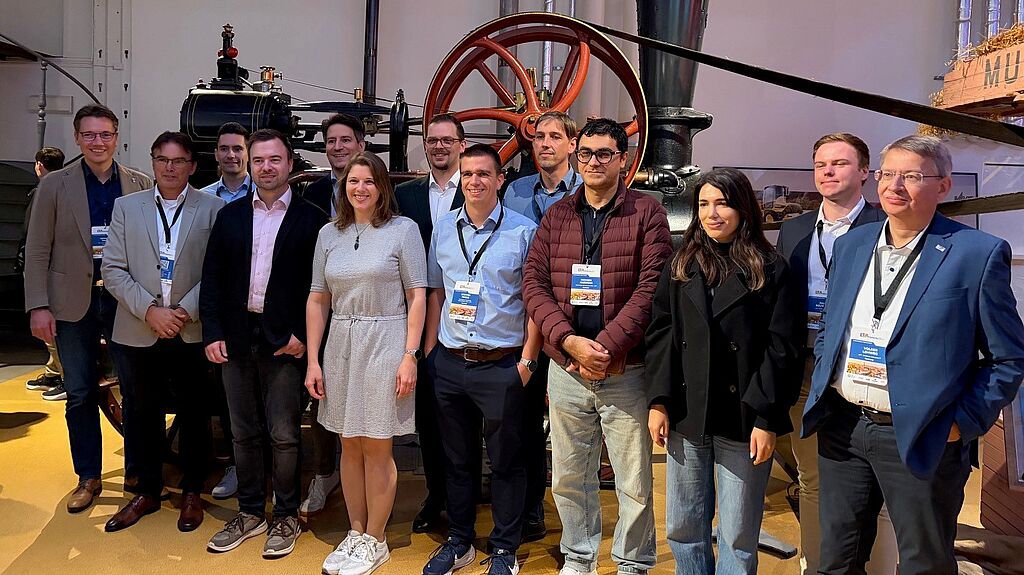
Even outside the conference programme, the ETFA provided an opportunity for international exchange. A particular highlight was the conference banquet at the Munktell Museum in Eskilstuna. Surrounded by historic industrial machinery, participants were able to continue their discussions, make new contacts and round off the conference day together.