

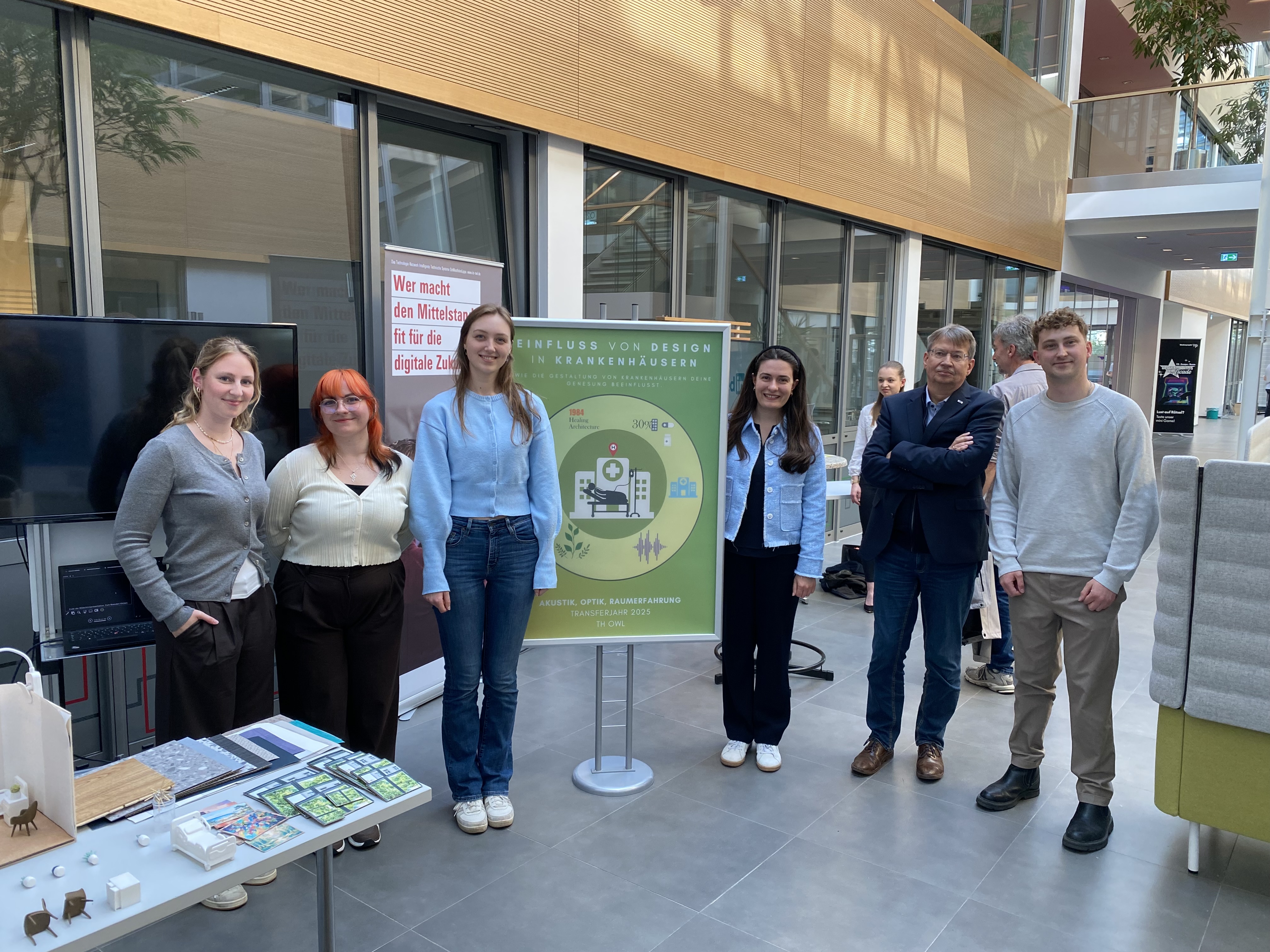
On 24 April 2026, the project showcase of the Transfer Year 2025 of the Technische Hochschule OWL took place at the CENTRUM INDUSTRIAL IT on the Innovation Campus Lemgo. The Discrete Systems working group, led by Prof. Dr. Volker Lohweg, took part in the project showcase with the project “Neural perception in medical rooms” in the context of acoustics, optics and spatial experience.
Transfer Year 2025
As part of the Transfer Year 2025, TH OWL had invited the OWL region to submit real-world challenges and questions. The response was overwhelming. During the 2025/2026 winter semester, interdisciplinary student teams worked on innovative solutions.
Design of medical rooms
One of the projects: the design of medical rooms. Three Bachelor’s students from the departments of Business Psychology and Interior Design enthusiastically explored the question of how medical rooms can be designed to promote the well-being and, consequently, the recovery of patients. This involves aspects such as clear layouts, pleasant colours, good lighting, and a sensible arrangement of furniture, equipment and acoustics. Over the course of the project, the students examined neural perceptions in medical rooms in depth and developed creative solutions for how an optimal indoor environment may contribute to patients’ recovery.
Design your own hospital room
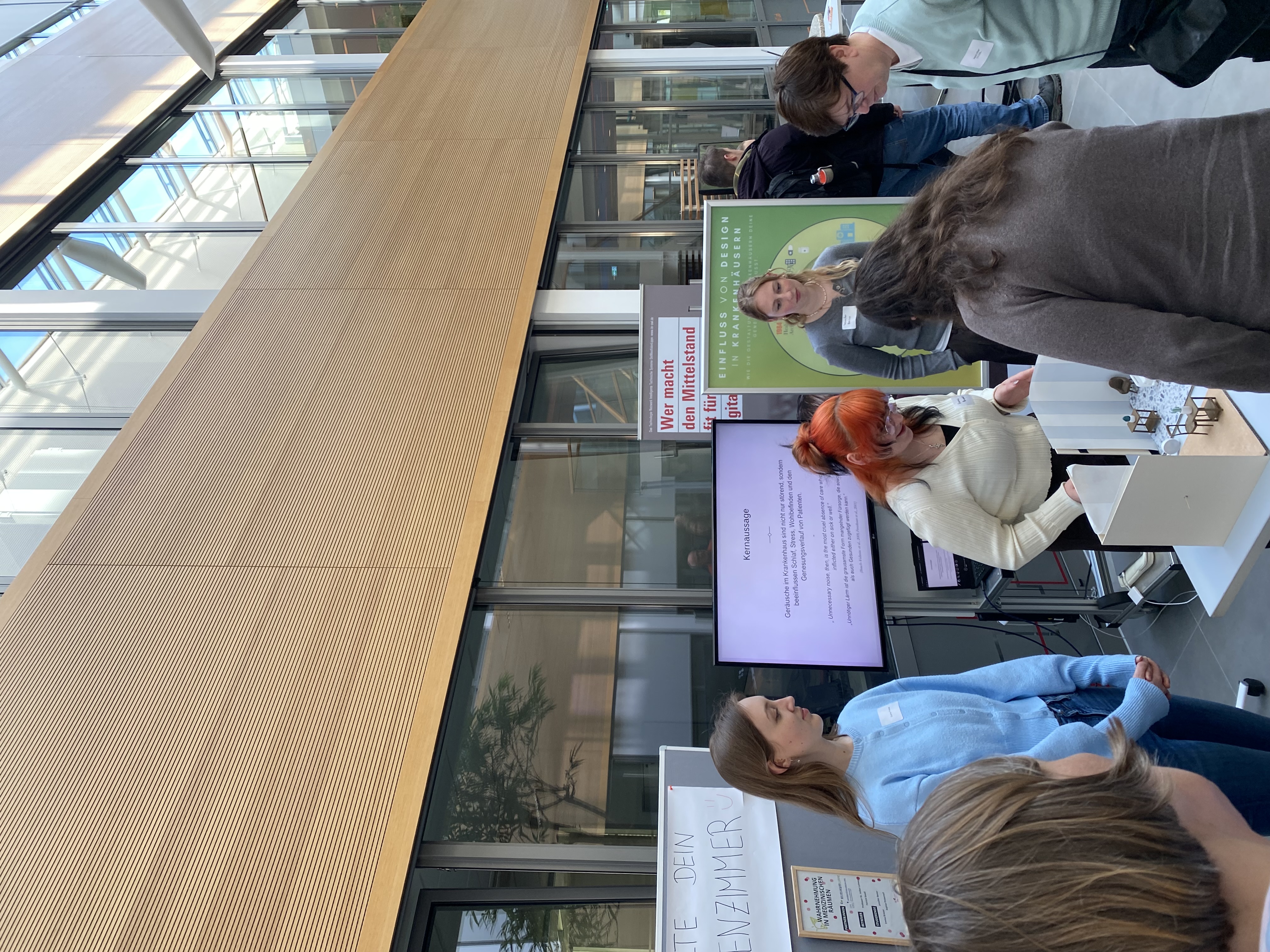
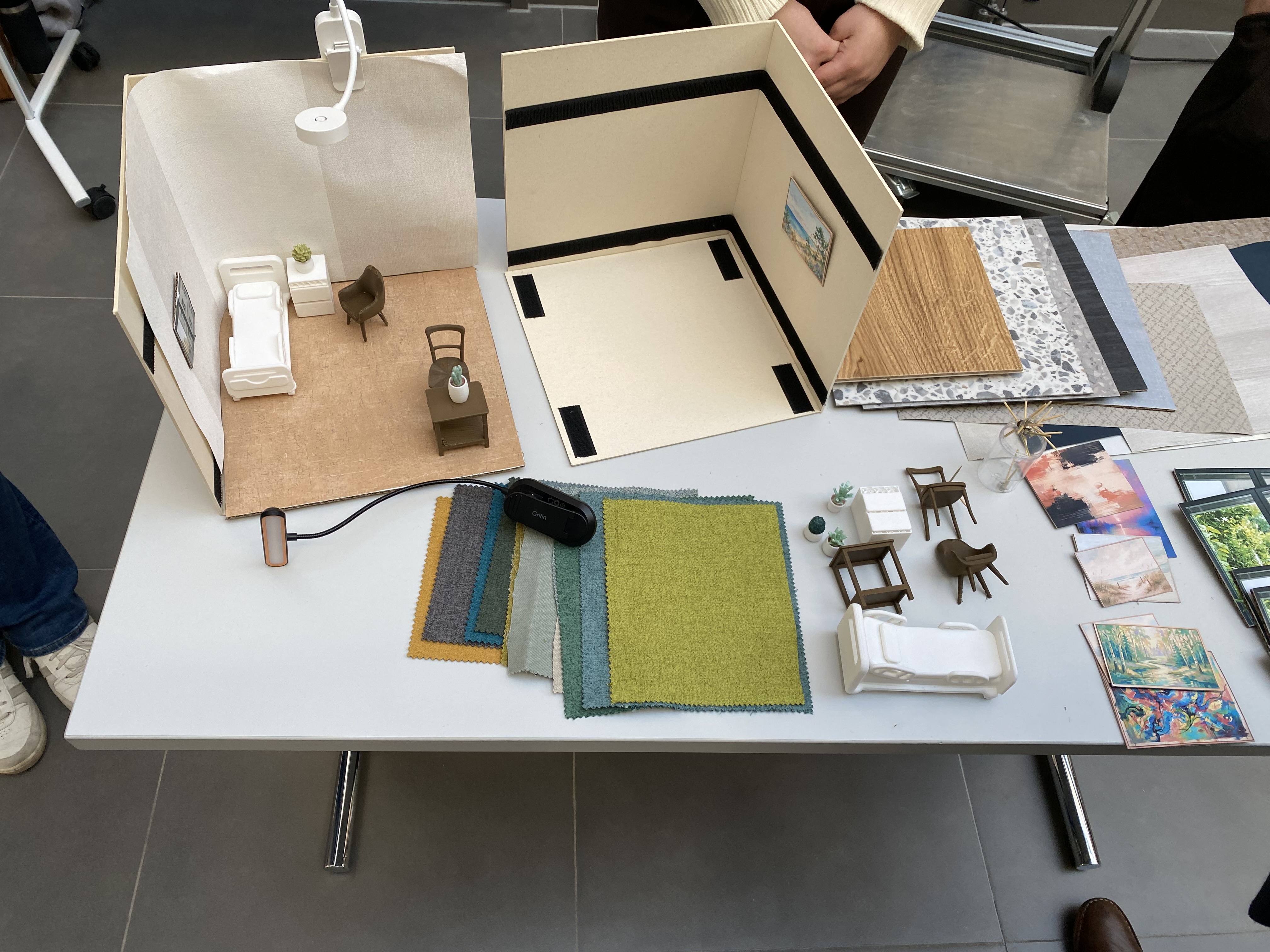
Highly motivated, Jennifer Besier (Business Psychology), Emma Brauer (Interior Design) and Sophia Pinkernell (Interior Design) presented two different physical models of a hospital room that they had developed. At the always well-attended interactive stand, visitors were able to design their own hospital room using a modular approach. They could choose from various pieces of furniture, wallpapers, lighting, decorations and more. It was precisely this practical applicability that met with great interest from more than hundred visitors to the project showcase. The work of the dedicated students received consistently positive feedback.
Complex project
The task was complex: on the one hand, sensory and psychological aspects had to be taken into account for the benefit of patients; on the other hand, the aim was also to potentially improve the working conditions of medical staff. For this reason, the students received support from Prof. Dr. Volker Lohweg, head of the Discrete Systems working group, and Patrick Gaudl, research associate in the group. The Discrete Systems working group conducts research into medical and health technologies, among other areas, and works closely with Klinikum Lippe. Dr. Laura Moradbakthi also contributed her expertise to this transfer project. In cooperation with the District of Lippe, she is conducting research into AI and digital assistance systems in the healthcare sector.
Prof. Dr. Volker Lohweg and Dr. Laura Moradbakthi agree: “By the two models and various options, people may intuitively decide how they would feel most comfortable in a medical room. The task has been executed superbly.”