

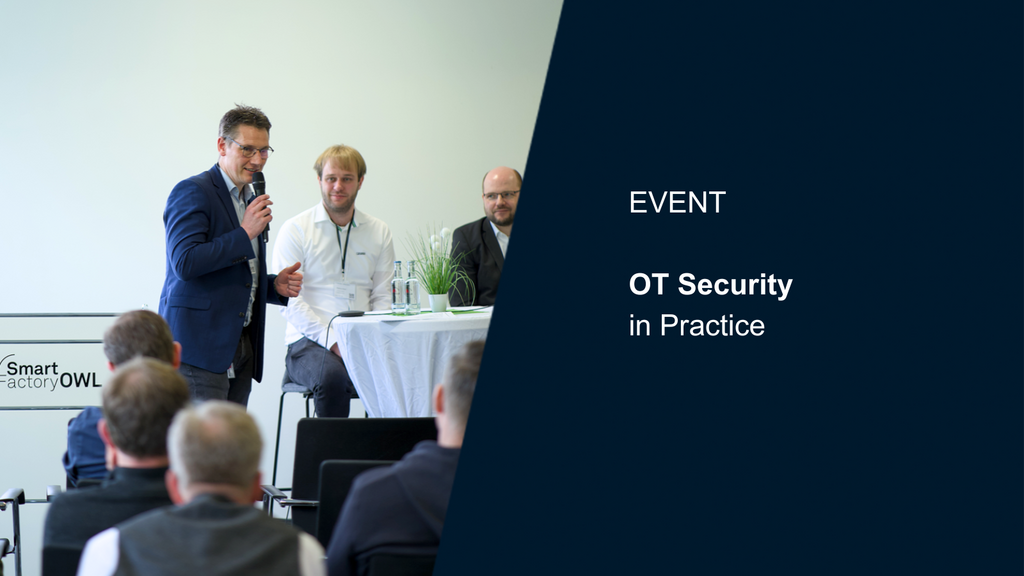
Experts from industry and research are discussing cybersecurity and new regulatory requirements at SmartFactoryOWL.
Cyberattacks on production facilities are posing ever-greater challenges for companies. At the same time, new regulatory requirements, such as the “Cyber Resilience Act” (CRA) and the “NIS 2 Directive,” are ensuring that cybersecurity continues to gain in importance. How these requirements can be implemented in practice was the central theme of the “OT Security Tag” event at SmartFactoryOWL in Lemgo.
Approximately 60 participants from industry and research accepted the invitation from rt-solutions.de GmbH, inIT, Fraunhofer IOSB-INA, and CENTRUM INDUSTRIAL IT e. V. Through technical presentations, a panel discussion, and hands-on workshops, they exchanged ideas on current challenges and concrete solutions for enhancing cybersecurity in industrial production..
Cybersecurity as a shared responsibility
The event demonstrated that cybersecurity is no longer merely a technical issue. Rather, it affects companies throughout the entire value chain—from component manufacturers and machine builders to production facility operators. The participants’ perspectives were correspondingly diverse.
Insights into new requirements
The technical presentations covered topics such as practical experiences with NIS-2 and how the provisions of the Cyber Resilience Act can be translated into specific requirements for cyber-secure products. The focus was on practical implementation recommendations for companies.
Exchange along the value chain
During the panel discussion “Cybersecurity in the Supply Chain,” moderated by Prof. Dr. Henning Trsek, Director of the inIT Institute, representatives from component manufacturers, mechanical engineering companies, and plant operators discussed pragmatic approaches to scalable security. It became clear that issues such as vulnerability management, security updates, and risk assessments can only be effectively addressed through collaboration and shared responsibility across the entire supply chain.
“The fact that we’ve been able to bring together so many perspectives from industry and research here at the Innovation Campus Lemgo is exactly what’s needed when it comes to this topic. Cybersecurity in manufacturing cannot be addressed through regulation alone, but rather through dialogue, concrete real-world examples, and collaboration across the value chain,” says Prof. Dr. Henning Trsek.
Putting Cybersecurity into practice
In the afternoon, the event featured four hands-on workshops. There, participants were able to learn about specific methods and tools, such as those for securing production systems against ransomware, conducting product risk assessments according to the CRA, implementing NIS 2 requirements, and performing security monitoring in industrial networks.
The event made it clear that new regulatory requirements bring not only obligations but also opportunities—such as greater transparency, robust processes, and closer collaboration between industry and research.
Auther: Mona Marie Brinkmann