

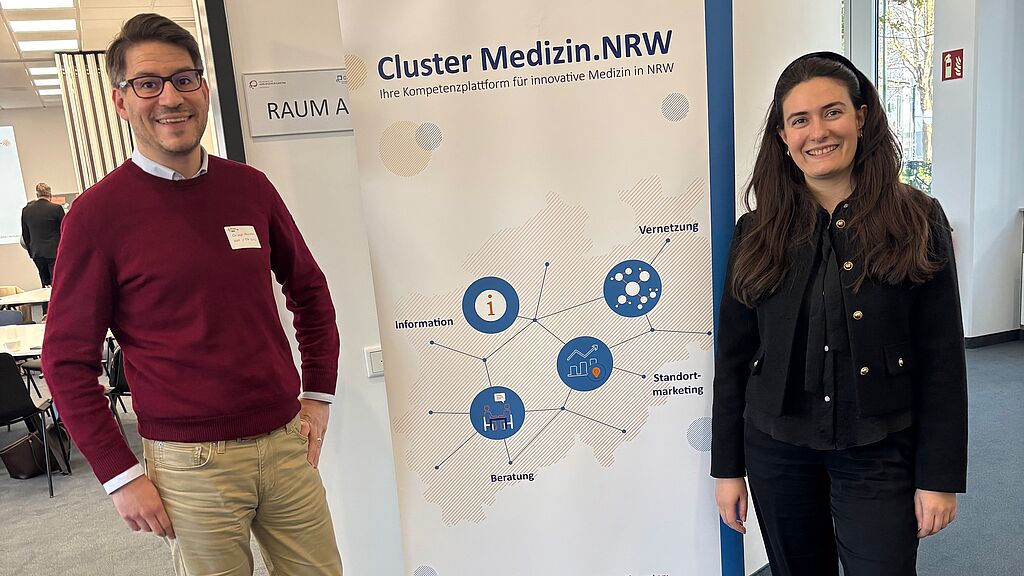
How can large language models support healthcare professionals and patients? And what obstacles stand in the way of their widespread use in the healthcare sector? Dr. Christoph-Alexander Holst and Dr. Laura Moradbakhti discussed the opportunities and challenges of AI-based healthcare applications at the Cluster Medizin.NRW Lighthouse Forum on 4 November 2026 in Düsseldorf.
AI as a support in everyday medical practice
In a keynote presentation entitled “From LLM to clinical AI assistant: the potential and practical hurdles of AI-based healthcare applications”, Dr. Holst highlighted the opportunities offered by modern AI technologies for medical care – whilst also demonstrating why the path from powerful language models to reliable assistance systems still presents numerous challenges.
The volume of specialist medical literature is growing continuously. It is becoming increasingly difficult for doctors to quickly access relevant information in the already time-pressured day-to-day practice of healthcare. AI-based assistance systems can provide support here, for example by making specialist medical knowledge accessible, consolidating information from various sources and assisting with documentation.
Dr. Holst and Dr. Moradbakhti, who jointly lead the Discrete Systems research group, illustrated how such approaches might work in practice using the example of the PD Assist research project. The application, developed at inIT, is designed to support people with Parkinson’s and healthcare professionals through digital documentation, the integration of sensor data and AI-supported assistance functions. The KILABS research project, which aims to provide dialogue-based medical guidelines and recommendations for antibiotic therapy, was also highlighted as a further example of application.
Technical possibilities meet structural hurdles
Despite the great potential, the use of AI assistants in clinical settings is subject to specific requirements. In particular, the reliability of AI-generated responses poses a key challenge: language models can provide information that is convincingly phrased but factually incorrect. In healthcare, such risks must be weighed up with particular care.
In addition to these technical issues, Dr. Holst also addressed the specific organisational and regulatory framework governing medical AI applications. Issues relating to data availability and integration, data protection, liability and regulatory classification must be taken into account during the development and introduction of such systems. This makes close collaboration between research, medical practice and other stakeholders all the more important.
Shaping the transition to clinical practice together
To make the best possible use of the opportunities offered by AI-based healthcare applications, Dr. Holst emphasised the importance of practice-oriented research and joint testing of new technologies.
“The development of clinical AI assistants is most successful when there is close collaboration between research and clinical practice. Joint pilot projects offer the opportunity to test innovative approaches under realistic conditions, assess their benefits and gather beneficial experience for further implementation,” said Dr. Holst.
The Lighthouse Forum provided a suitable platform for this. In the subsequent World Café, stakeholders from research, the healthcare sector and other fields discussed shared needs, challenges and potential areas for action. The lively discussions surrounding the event also gave the two inIT researchers the opportunity for professional exchange and opened up avenues for potential future collaborations.