

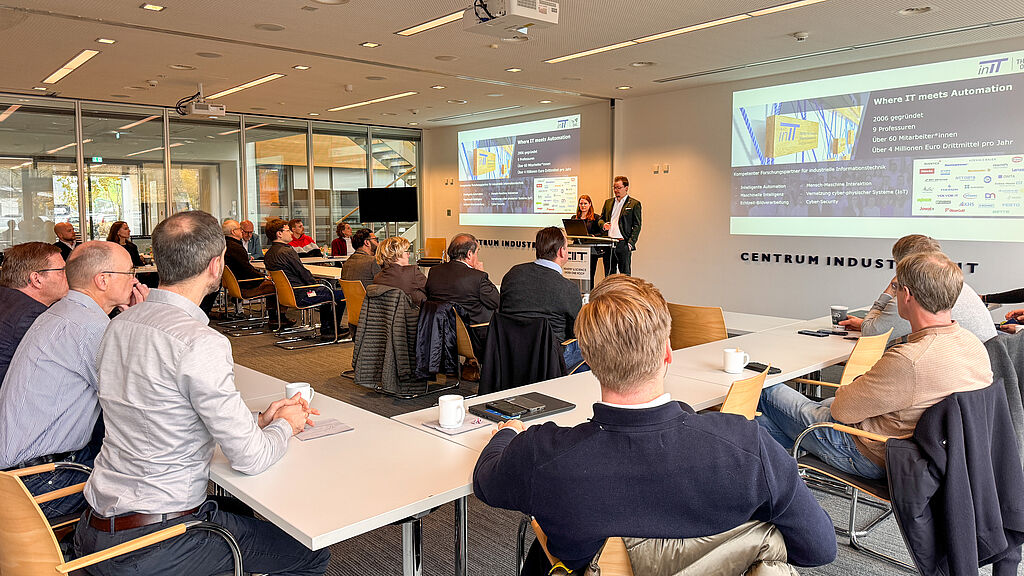
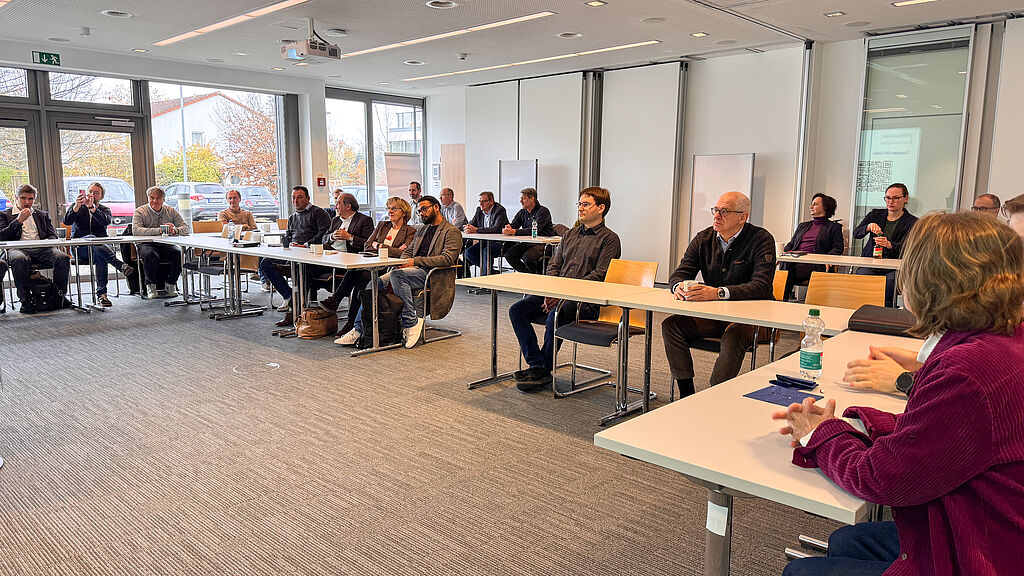
The Digital Product Passport offers companies far more than a means of complying with regulatory requirements. Combined with the Digital Twin, it opens up new opportunities for industrial digitalisation. Drawing on recent research findings from the DiPP project, Philip Sehr and Laura Reinke, researchers in the Interconnected Automation Systems research group led by Prof. Dr. Henning Trsek, demonstrated how these opportunities can be realised in practice. The occasion was a meeting of the it’s OWL focus group “Digital Twin”, held as part of the CIIT Coffee Talk in Lemgo.
The it’s OWL focus group “Digital Twin” brings together experts from academia and industry to support companies in advancing their digital transformation through Digital Twins. Against the backdrop of current European regulatory developments, the Digital Product Passport (DPP) is gaining increasing attention. As a tool for making product-related information digitally available, it offers a wide range of applications, although its implementation still presents challenges for companies.
From the Digital Twin to the Digital Product Passport
In the research project Digital Product Passport for Reliable Information Exchange in the Supply Chain (DiPP), the Lemgo-based researchers investigate how the Digital Twin can serve as a technological foundation for the Digital Product Passport and what additional value this can generate for companies.
“No company wants to undertake extensive and costly digitalisation of its processes simply to meet a regulatory requirement. Instead, the DPP should be seen as an opportunity to unlock further benefits of digitalisation,” explains Philip Sehr.
One of the project's research priorities is digital quality management. To this end, the research team has developed methods for automating quality inspections and digitally documenting the results. Standardised information models of the Asset Administration Shell (AAS) are used to orchestrate quality management processes and process the resulting data. The aim is to facilitate scalability and enable interoperability of the developed solutions.
Transparency across the Value Chain
Another focus of the project is the aggregation of product information and evidence of raw material provenance.
“The sustainability of a product is strongly influenced by its raw materials and transport routes. This information is therefore important for metrics such as the Product Carbon Footprint,” explains Laura Reinke.
As part of the DiPP project, various information models are being developed to digitally represent individual stages of the value chain and the product life cycle.
“By combining these information models with the resources used, it is possible to trace the origin of all product components and the entire product life cycle,” Laura Reinke adds.
A Digital Product Passport for a Cup of Coffee
Participants at the CIIT Coffee Talk had the opportunity to experience first-hand how the technologies and concepts developed in the project work together: the robotic coffee bar CinITo not only provided refreshments at the event but also served as a research demonstrator.
With every beverage prepared, guests receive an individual Digital Product Passport that brings together the various research areas of the DiPP project.
“A tangible demonstration is always better than a theoretical explanation of concepts. Our research thrives on its close connection to real-world applications and should therefore be presented in a practical way,” says Philip Sehr.
The research approaches presented were well received by participants from industry. Their positive feedback highlights the practical relevance of the research questions addressed in the DiPP project.
Learn more about DiPP: https://www.init-owl.de/forschung/projekte/detail/digitaler-produktpass-fuer-zuverlaessigen-informationsaustausch-in-der-supply-chain/
Author: Mona Marie Brinkmann