

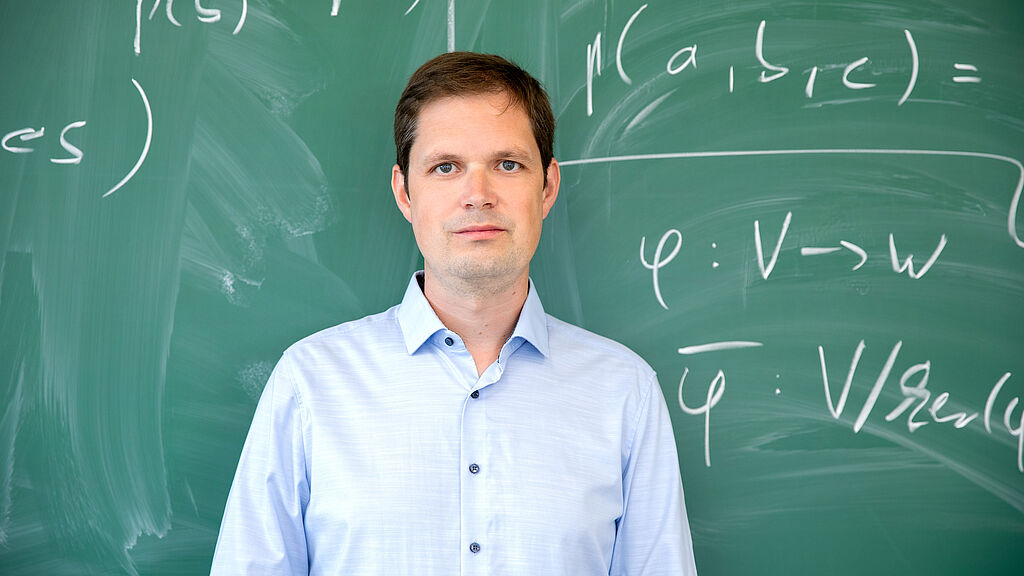
The paper “Fast Reconstruction of Exact Maxwell Dynamics from Sparse Data”, co-authored by Prof. Dr. Markus Lange-Hegermann and an international research team, has been selected as a Spotlight at NeurIPS 2026. This distinction highlights the paper as one of the specially recognised contributions at this year's conference.
Physical knowledge embedded directly in the AI model
Prof. Dr. Markus Lange-Hegermann and an international research team have had their paper “Fast Reconstruction of Exact Maxwell Dynamics from Sparse Data” selected as a Spotlight at NeurIPS 2026. With its selection as a Spotlight, the paper is among the contributions receiving special recognition at this year's conference.
The work by Dan DeGenaro, Xin Li, Obed Amo, Michael Pokojovy, Sarah Adel Bargal, Markus Lange-Hegermann and Bogdan Raiţă focuses on FLASH-MAX, a newly developed machine learning architecture. It is designed to reconstruct electromagnetic fields from only a small number of point measurements while exactly satisfying the underlying Maxwell equations.
This sets the approach apart from many established methods in Scientific Machine Learning: Physical laws are not merely incorporated as additional constraints during training but are built directly into the structure of the neural network. Each neuron in the hidden layer itself represents an exact solution to Maxwell’s equations.
In the experiments described in the paper, FLASH-MAX achieves a relative validation error of less than one percent within just a few seconds using around 1,000 measurement points. At the same time, the solution remains mathematically consistent with Maxwell’s equations. Even with only 100 measurement points, the results still demonstrate comparatively high accuracy.
An international stage for Machine Learning
The work will be presented at NeurIPS 2026, one of the world’s most important conferences for Machine Learning and Artificial Intelligence. Researchers from around the globe present current developments and discuss new approaches from a wide range of areas in AI research.
A look at the previous year illustrates just how competitive publication at NeurIPS is: In 2025, around 21,600 papers were submitted to the Main Track, with only about one quarter being accepted.
In 2026, the conference will take place for the 40th time and, for the first time, across three locations simultaneously: in Sydney, with official satellite venues in Atlanta and Paris.
Prof. Dr. Markus Lange-Hegermann is also involved in NeurIPS beyond the paper itself. As a Senior Area Chair in Scientific Machine Learning, he is coordinating the peer review process for around 125 submitted papers this year. In the previous two years, Prof. Dr. Markus Lange-Hegermann had already served as an Area Chair for the conference.
“NeurIPS is one of the most important international conferences in our research community. We are therefore particularly pleased that our work has been accepted, and we see this as strong recognition of our approach in Scientific Machine Learning,” says Prof. Dr. Markus Lange-Hegermann.
Author: Mona Marie Brinkmann