

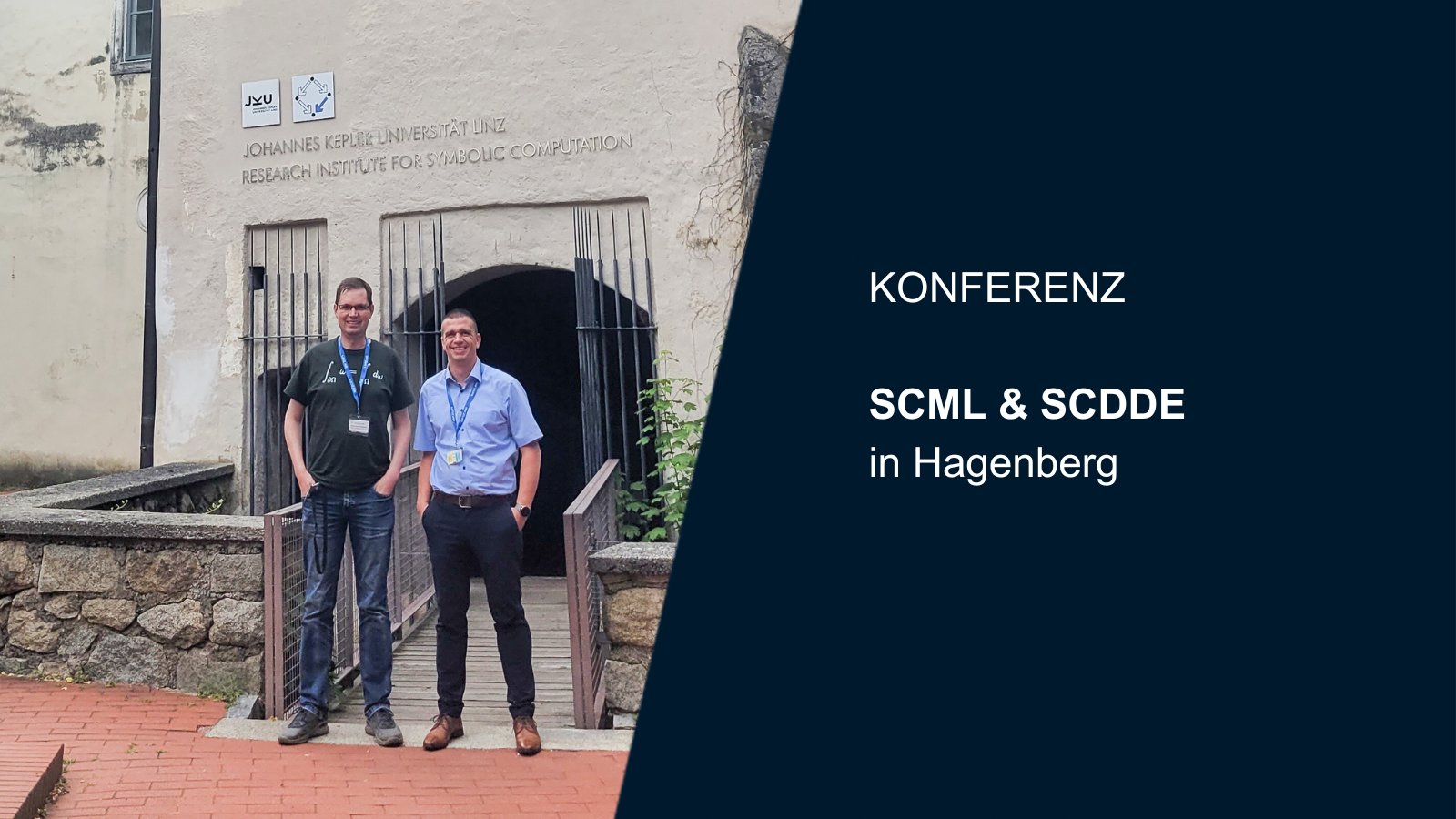
Prof. Dr. Markus Lange-Hegermann and Steffen Fricke represented inIT at the international conference “Symbolic Computation and Machine Learning” and the accompanying workshop “Symbolic Computation and Differential and Difference Equations” (SCML & SCDDE 2026) in Hagenberg, Austria. The entire event took place from July 6 to 10, 2026, at the Research Institute for Symbolic Computation (RISC) and was part of RISC Summer 2026. The SCML ran from July 6 to 8, and the accompanying SCDDE workshop from July 8 to 10. The focus was on current research questions at the intersection of symbolic computation, machine learning, formal methods, and differential equations.
Bringing mathematics and AI together
SCML & SCDDE 2026 focused on the integration of two central approaches in artificial intelligence: symbolic computation and machine learning. Topics discussed included hybrid AI approaches, explainable and verifiable AI, the integration of large language models with formal methods, and applications in mathematical software systems.
In doing so, the conference addressed a field of research that is currently gaining significant importance: How can learning systems be combined with mathematical structural knowledge so that AI applications become not only more powerful, but also more transparent and reliable? In addition to the scientific presentations, the event provided a forum for exchanging ideas on new research approaches, potential collaborations, and future projects.
Two contributions from inIT
inIT was represented at SCML & SCDDE 2026 with two presentations. The talks offered different perspectives on current AI research: ranging from the mathematical foundations of machine learning to the application of large language models in network engineering.
Differential-Algebraic Machine Learning
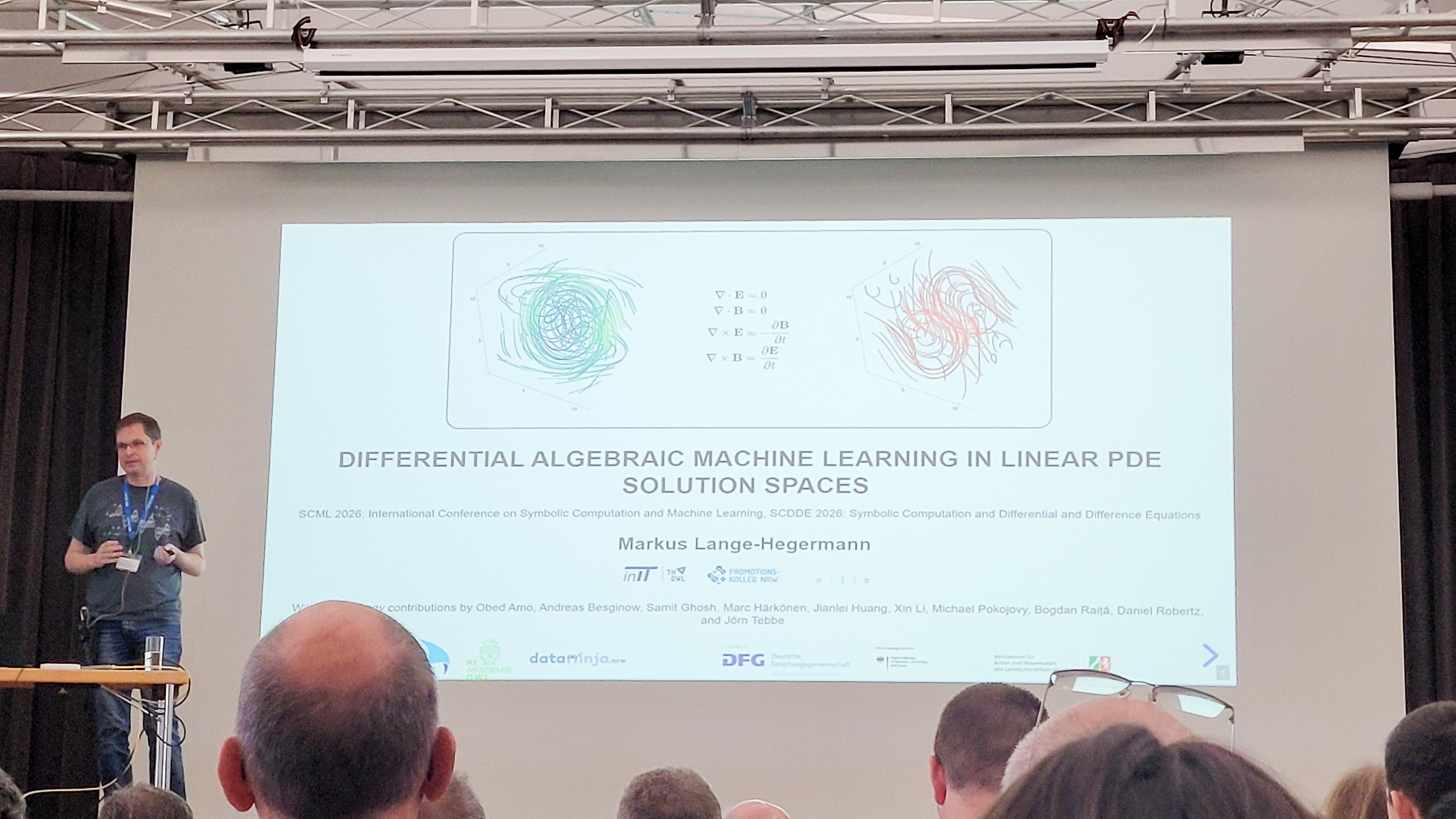
Board member Prof. Dr. Markus Lange-Hegermann was invited to speak. In his presentation, “Differential Algebraic Machine Learning in Linear PDE Solution Spaces,” he demonstrated how differential-algebraic methods and machine learning can be combined.
“I was very pleased to receive the invitation because the conference brings together many topics that also shape my research: mathematical structures, machine learning, and the question of how the two can be meaningfully combined. The exchange with researchers from different fields was accordingly exciting,” says Prof. Dr. Markus Lange-Hegermann.
LLM-Based Configuration of 5G Networks
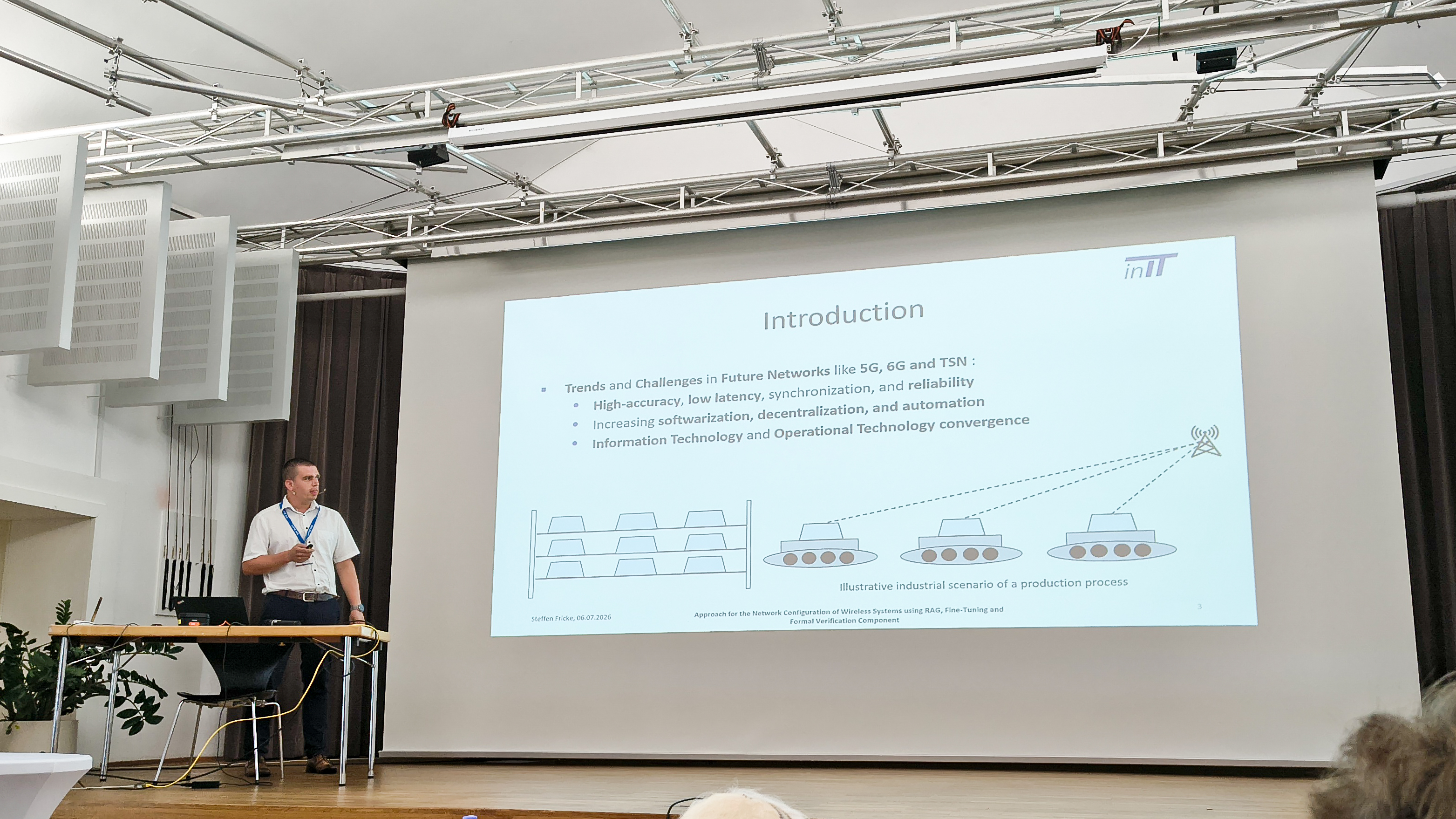
Steffen Fricke, a research assistant and doctoral candidate in the Computer Networks research group led by Prof. Dr. Jürgen Jasperneite, presented the paper “Approach for the Network Configuration of Wireless Systems Using RAG, Fine-Tuning, and Formal Verification.” In it, he presented a concept for LLM-based configuration of 5G networks that combines retrieval-augmented generation, fine-tuning, and formal verification.
“For me, the conference was particularly exciting because I was able to present our topic in an international setting and discuss it with researchers from a wide variety of fields. It was very valuable to look beyond my own field of expertise,” says Steffen Fricke.
Exchange at the Hagenberg Research Center
The supporting program also offered insights into Hagenberg as a hub for research and technology. It included a guided tour of the Hagenberg Software Park, founded by Austrian mathematician Bruno Buchberger, and a presentation by Stephen Wolfram, founder of Wolfram Research and developer of Mathematica. The conference dinner on the terrace of the Parkhotel Hagenberg also provided an opportunity for conversation and professional exchange.
“We are pleased that our contributions from inIT allowed us to be part of this thoroughly successful event and to help shape the dialogue in this dynamic field of research,” says Prof. Dr. Markus Lange-Hegermann
Auther: Mona Marie Brinkmann