

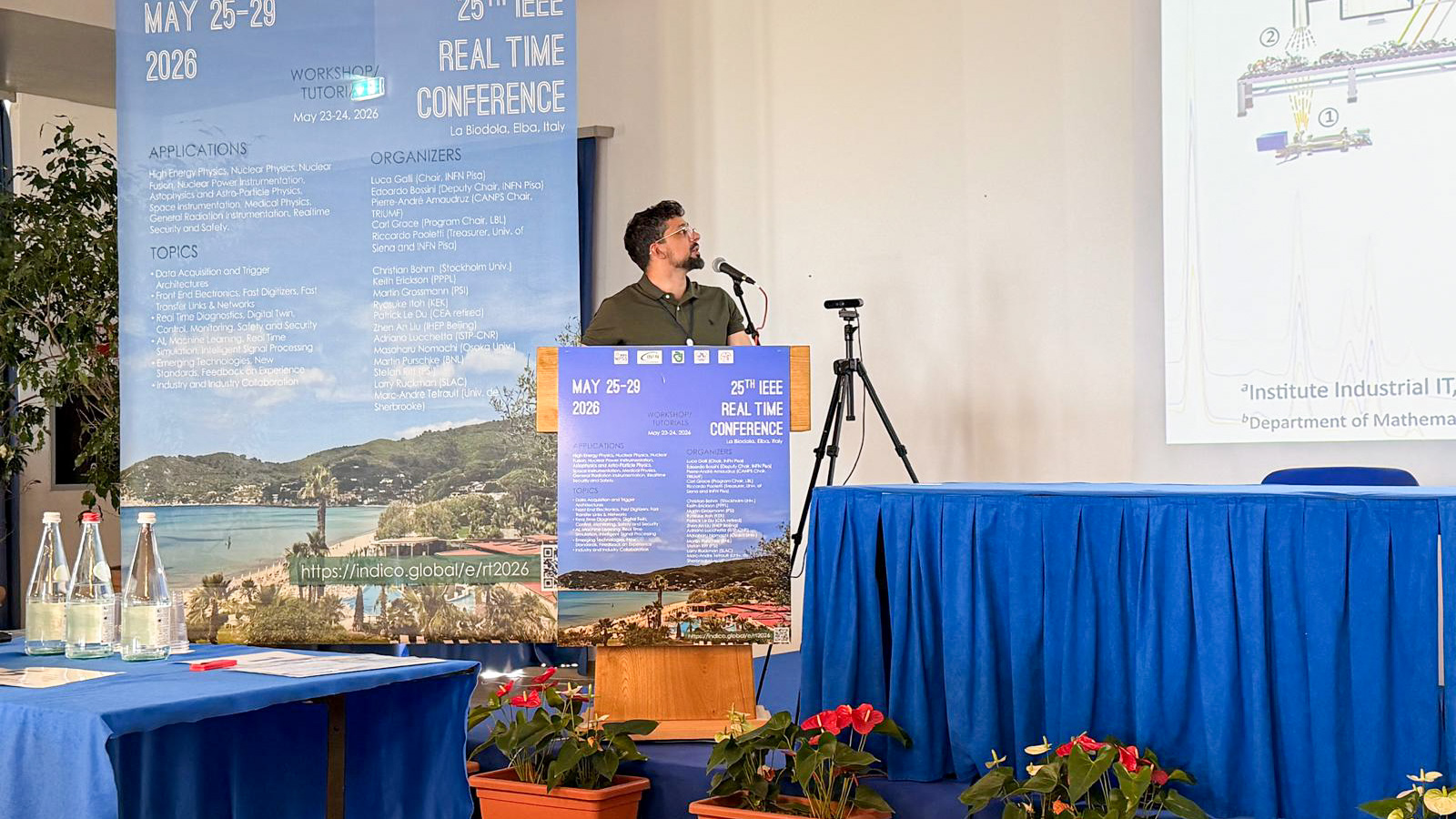
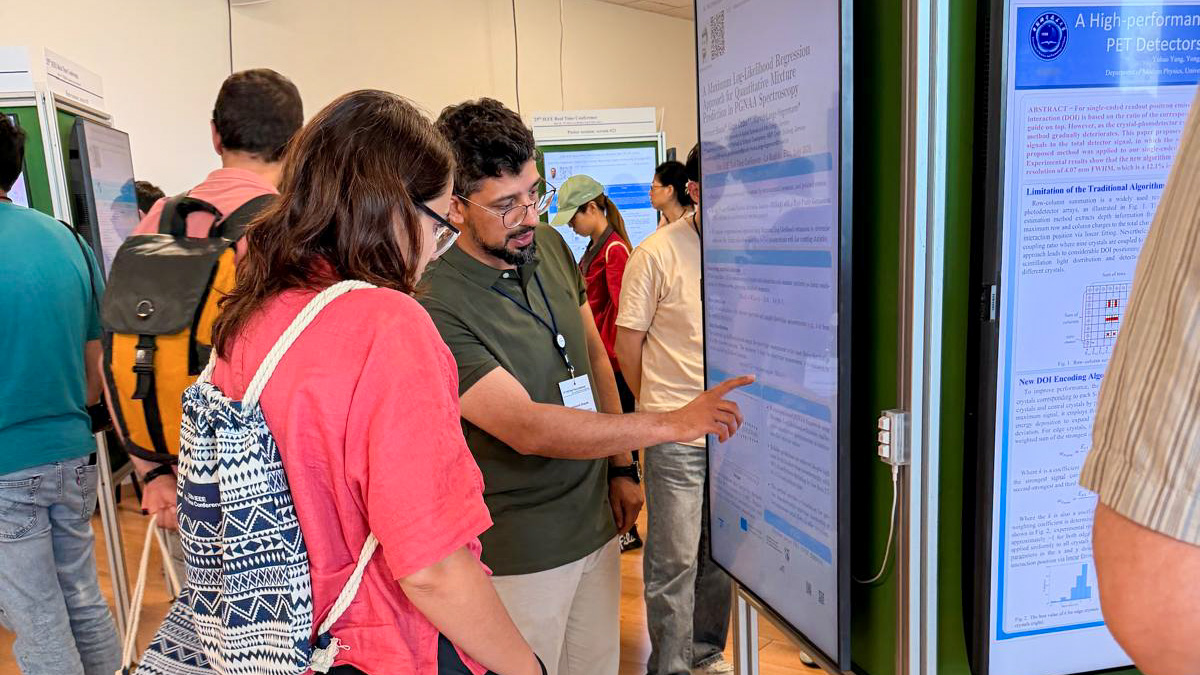
How can metal alloys be analysed quickly and non-destructively in recycling processes – while not only assigning them to a material class, but also determining their exact composition? This is the question Helmand Shayan from the Mathematics and Data Science research group is addressing. He presented a new approach at the 25th IEEE Real Time Conference on the Italian island of Elba in a “Mini Oral” talk followed by a poster presentation.
Helmand Shayan is a research associate in the Mathematics and Data Science research group led by Prof. Dr. Markus Lange-Hegermann. The paper, co-authored with Gözde Özden and Prof. Dr. Markus Lange-Hegermann, is titled “A Maximum Log-Likelihood Regression Approach for Quantitative Mixture Prediction in PGNAA Spectroscopy”.
Mixture ratios instead of fixed material classes
The work focuses on Prompt Gamma Neutron Activation Analysis, or PGNAA. The method enables non-destructive analysis of the elemental composition of materials. While conventional classification approaches assign materials to fixed categories, mixed material streams also require information about the proportions in which different alloys are present.
This is where the new approach comes in: Using a regression-based maximum log-likelihood method, the research team determines mixture ratios even from short and statistically noisy measurements. The method is based on synthetic mixtures generated from reference spectra of different alloys.
The results show a high level of accuracy: For aluminium-copper mixtures with a measurement time of just 1.5 seconds, 98 percent of the predictions deviated by less than two percent from the actual mixture ratio. The method also proved robust across other alloy combinations. The work therefore provides a basis for fast, non-destructive online analysis of metal streams.
“For metal recycling, it is important to be able to determine mixture ratios quickly and accurately. Our results show that this is possible even with very short measurements. This brings us an important step closer to automated online analysis of metal streams,” says Helmand Shayan.
From real-time AI to team culture and networking
The IEEE Real Time Conference brings together research and industry around technologies for real-time data processing. The scientific programme ranged from high-speed electronics and data acquisition to monitoring, digital twins, artificial intelligence and machine learning.
Even before the official start of the conference, a two-day pre-conference programme offered practical insights into AI for embedded systems. In hands-on workshops, participants explored, among other things, how neural networks can be implemented on specialised hardware such as FPGAs using open-source tools. The technical programme was complemented by opportunities for exchange and networking. At the Women in Engineering event, topics included team culture, performance pressure and work-life balance in research.
“The conference covered a very broad range of topics and was excellently organised. I particularly appreciated the combination of current research topics, hands-on workshops and direct exchange between academia and industry,” Helmand Shayan concludes.
Author: Mona Marie Brinkmann