

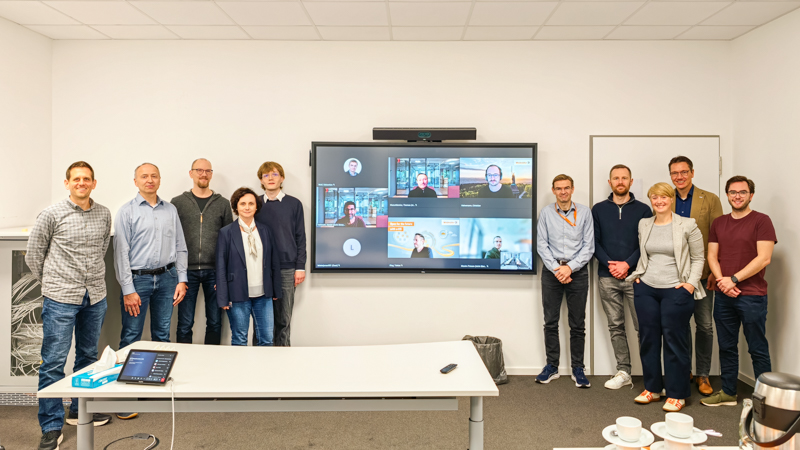
The project team reviews the results and presents the developed software solution
How can security risk assessments in industry be made more efficient without compromising the thoroughness of the analyses? This was the central question addressed by the SUSI research project over the past three and a half years. On October 5, 2026, the project partners gathered at Weidmüller in Paderborn for a final meeting to reflect on their collaboration and present the software solution developed during the project.
At inIT, SUSI – “Software-Based Support for Security Risk Assessments in Industry” – was based in the Networked Automation Systems research group led by Prof. Dr. Henning Trsek. He attended the final meeting together with research group leader Natalia Moriz and research associate Simon Jonas Leister.
AI-based support for complex risk assessments
Security risk assessments play an important role in systematically identifying threats and vulnerabilities in industrial components and systems and evaluating the resulting risks. As industrial systems become increasingly interconnected and regulatory requirements grow, particularly through the Cyber Resilience Act and the NIS2 Directive, their importance continues to increase. At the same time, such assessments often require considerable time and resources.
This is where SUSI came in: The project aimed to increase the level of automation in security risk assessments, reduce the workload for professionals and make existing processes more efficient.
As part of the project, the team developed a software solution combining large language models with Retrieval-Augmented Generation (RAG). The software uses information about the components being assessed as well as relevant threat databases to help users carry out security risk assessments more systematically and efficiently.
Tested in an industrial environment
The software solution was tested and evaluated in collaboration with Weidmüller. At the final meeting, the project team presented the project's initial challenges, objectives and development stages, with a particular focus on demonstrating the software. In addition to the project partners, other Weidmüller experts from Product Security Management and Technology Development attended the meeting.
The results were met with considerable interest and sparked lively discussions about existing processes and potential improvements. The software itself also received positive feedback, with Weidmüller expressing interest in its continued use and further development.
“Against the backdrop of today's threat landscape and regulatory requirements, security risk assessments are becoming increasingly important for industrial companies, while also growing more complex and resource-intensive. With SUSI, we have demonstrated how AI-based approaches can provide practical support in this area. The fact that our work has already inspired new ideas for improving existing processes at Weidmüller is a particularly valuable outcome for us. This was made possible above all by the close and trusting collaboration between all project partners,” says Prof. Dr. Henning Trsek.
Academic development and publications
SUSI also contributed to academic development: Research topics from the project were incorporated into the doctoral research of Dr. Marco Ehrlich, who previously worked as a research associate at inIT and completed his doctorate in 2024. He is now working as a Senior Security Consultant at project partner rt-solutions. The project also resulted in a master's thesis and numerous scientific publications, posters and specialist contributions.
Three and a half years of research and knowledge transfer
After three and a half years, SUSI concludes as a research project that successfully combined academic development, application-oriented research and knowledge transfer. Together with Weidmüller, Comma Soft and rt-solutions, the project team developed and tested new approaches to making security risk assessments more efficient, laying the groundwork for potential future industrial applications.
More about the project: https://www.init-owl.de/forschung/projekte/detail/software-basierte-unterstuetzung-von-security-risikobeurteilungen-in-der-industrie/