

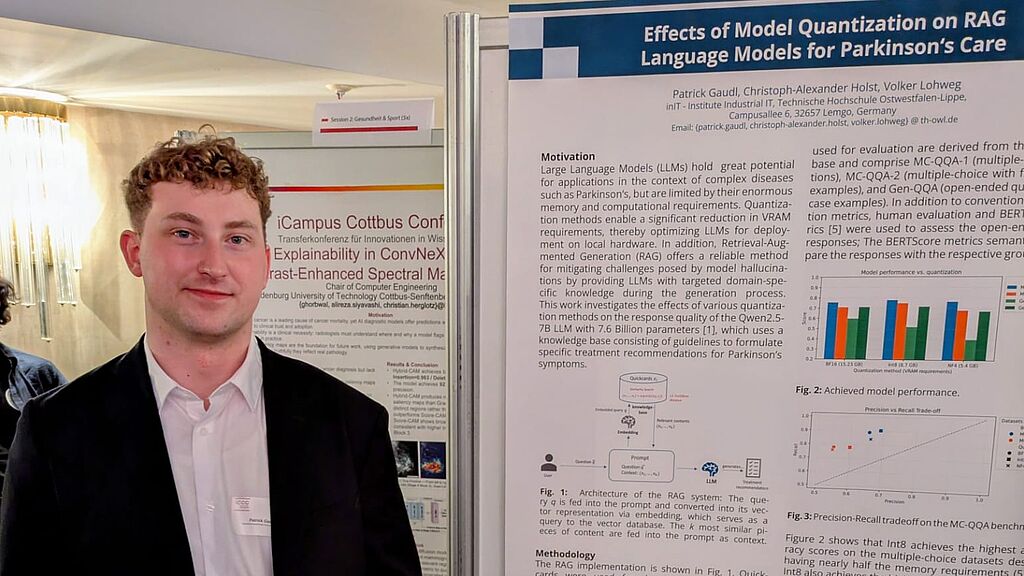
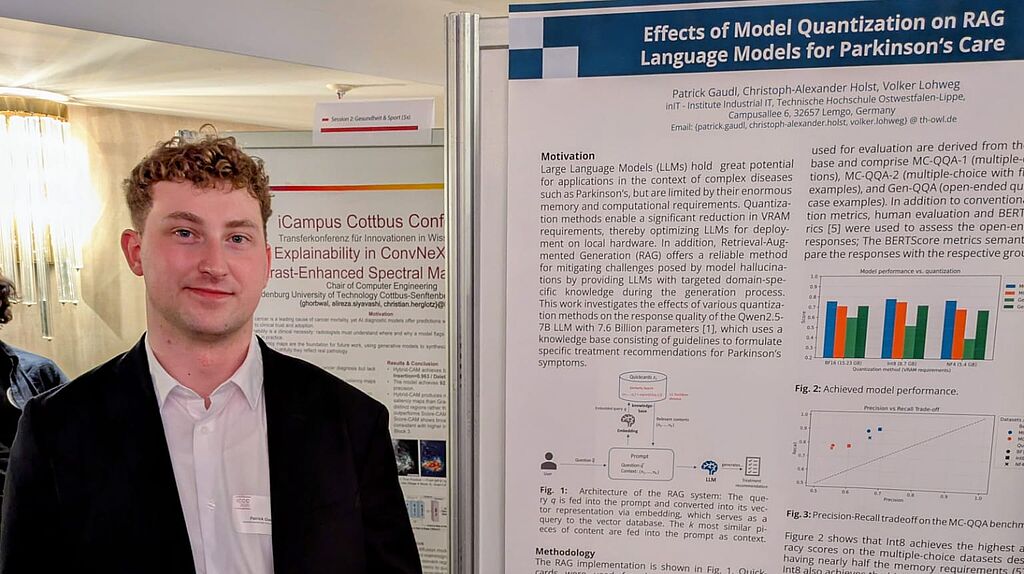
The iCampus Cottbus Conference (iCCC) took place from 5–7 May 2026. Its theme was “Sensors, MEMS & AI as key factors in structural change”, and it is designed as a transfer conference for innovations in science and industry. The iCampus is an innovation campus for electronics and microsensor technology at the BTU Cottbus-Senftenberg, which aims to drive forward digitalisation in the Lusatia region. Patrick Gaudl, a research associate in the Discrete Systems group led by Prof. Dr. Volker Lohweg, presented his research on Large Language Models (LLMs) there.
Poster presentation by Patrick Gaudl
In the “Health and Sport” session, Patrick Gaudl presented his poster, co-authored with Dr. Christoph-Alexander Holst and Prof. Dr. Volker Lohweg, entitled “Effects of Model Quantisation on RAG Language Models for Parkinson’s Care”. This is a highly topical issue, as LLMs in safety-critical fields such as medicine are, on the one hand, highly prone to errors and, on the other, often involve high resource consumption. Patrick Gaudl investigated the extent to which increasing memory reduction through quantisation affects the response quality of the models.
Resource conservation through sustainable AI applications
The Large Language Model under investigation takes on the role of a Parkinson’s advisor and answers questions regarding specific symptom clusters and fictional yet realistic case studies. Patrick Gaudl demonstrated that there was no deterioration in response quality in multiple-choice settings, despite a significant reduction in memory requirements. This enables deployment on limited and cost-effective hardware, conserves resources and contributes to the sustainability of AI applications.
Networking science and industry
In addition to the “Health and Sport” session, where Patrick Gaudl presented his poster, the iCCC 2026 addressed topics such as biosensor technology, environmental sensor technology and ultrasonic sensor technology. The keynotes and sessions focused on Artificial Intelligence and Machine Learning. A highlight of the conference was a guided tour of Europe’s most modern ICE train maintenance depot.
“In addition to the varied specialist presentations, there were also numerous interesting demonstrations. For me, the conference was an excellent opportunity to network with people from academia and industry,” concludes Patrick Gaudl.