

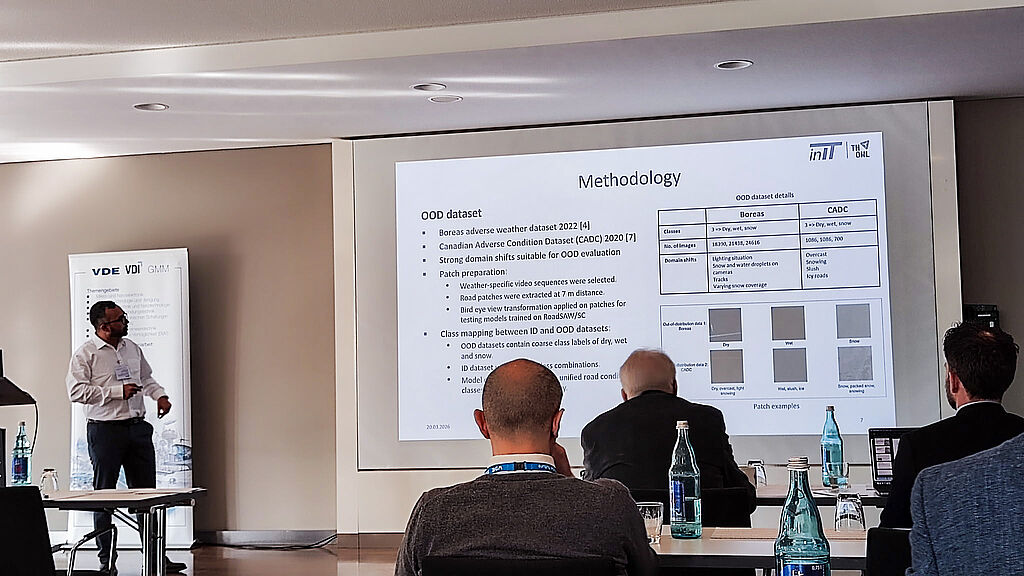

How reliably does an AI model perform when it encounters data that differs from what it was trained on? For automated vehicles, this question is crucial: Changing road conditions can push a vehicle beyond the limits of its intended operating domain. This is exactly what Ramakrishnan Subramanian, research associate in the Intelligent Systems research group led by Prof. Dr. Ulrich Büker, is investigating.
At Automotive meets Electronics and Control (AmEC) 2026 in Dortmund, Ramakrishnan Subramanian presented two contributions from his doctoral research. The conference brought together experts from academia and the automotive industry to discuss current developments in intelligent vehicle systems, connected mobility, and hardware and software concepts.
inIT research on robust AI for automated driving
With his poster “When Autonomous Vehicles Hit Their Limits”, Ramakrishnan Subramanian presented the motivation, objectives, and overall direction of his doctoral research. In his oral presentation, he focused on one specific aspect in greater depth: Together with fellow researchers, he is investigating how well neural networks for road condition classification generalize across different datasets – and how reliably they can identify situations in which reduced road friction causes an automated vehicle to leave its intended operating domain.
The key challenge is that strong performance on familiar test data does not automatically make an AI model reliable. In real-world applications, it is just as important that a model can cope with changing conditions and previously unseen data. Understanding this ability to generalize is therefore an important step towards developing robust perception systems for automated driving.
Insights from academia and industry
Beyond presenting his own research, Ramakrishnan Subramanian used the conference as an opportunity to exchange ideas with researchers and experts from the automotive industry. The direct feedback on his doctoral research was particularly valuable, helping him refine individual research questions and sharpen the direction of his work. The conference also created new opportunities for future exchange and collaboration.
“Direct feedback on my doctoral research was particularly valuable to me. The discussions gave me new perspectives and concrete ideas for the next steps in my research,” says Ramakrishnan Subramanian.
Auther: Mona Marie Brinkmann