

Digital Twin Day 2025 at the Innovation Campus Lemgo highlighted the role that digital twins can play in industry and research in the future. Specialist presentations, keynotes and demonstrations showed the enormous potential of this technology for transparency, sustainability and safety. Researchers from inIT also contributed practical insights into the diverse fields of application for digital twins.
Research for transparent value creation
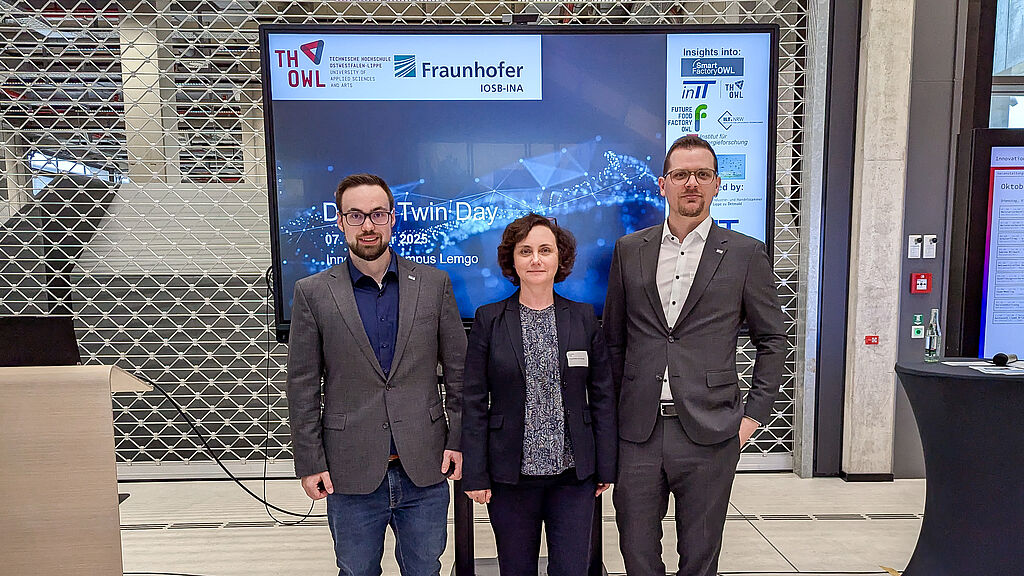
Philip Sehr, Robin Foster and Natalia Moriz, research group leader of the Networked Automation Systems working group headed by Prof. Dr. Henning Trsek, took part in the event organised by the Technische Hochschule Ostwestfalen-Lippe and Fraunhofer IOSB-INA. Research associates Philip Sehr and Robin Foster presented current research results from ongoing projects, while Natalia Moriz accompanied the event and supported the exchange with partners from science and industry.
Philip Sehr presented the Digital Product Passport for Reliable Information Exchange in the Supply Chain (DiPP) project, which shows how digital twins can contribute to greater transparency and sustainability in the food industry. The aim is to provide comprehensive product information along the entire value chain – from raw material extraction and manufacturing to disposal. This enables manufacturing companies to optimise their processes, while consumers are given a sound basis for making informed purchasing decisions.
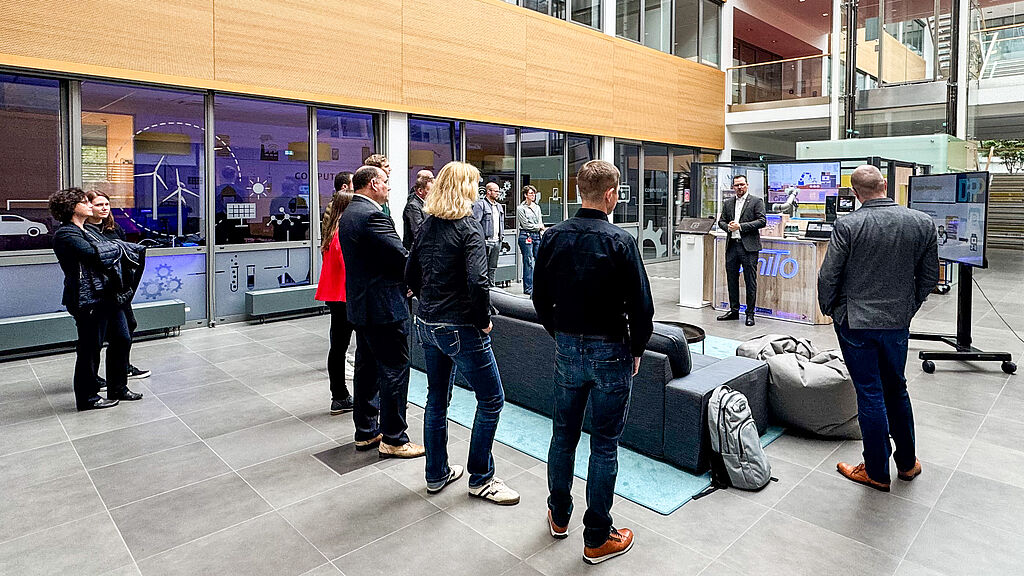
A clear example of this is the CinITo demonstrator, an automated coffee bar that illustrates the practical implementation of the digital product passport.
‘The digital product passport can become a key tool for measuring sustainability and transparency,’ explains Philip Sehr. ‘When data is available and trustworthy throughout the entire supply chain, both companies and consumers benefit.’
Digital twins for greater security
Robin Foster presented the GraphWatch project, which uses the administration shell (AAS) as a data basis for semi-automated threat hunting. The aim is to model digital twins in such a way that they map security-relevant information from industrial systems in a structured manner. This data then serves as the basis for graph-based machine learning processes that can be used to detect anomalies in OT networks. This allows potential security risks to be identified at an early stage and attacks to be better defended against.
‘Industrial systems are becoming increasingly complex and interconnected,’ says Robin Foster. ‘With GraphWatch, we are creating a basis for intelligently evaluating security-relevant data and automatically detecting threats – an important step towards a resilient Industry 4.0.’
Impulses from industry and research
Digital Twin Day 2025 offered a varied programme with keynotes, specialist presentations and practical workshops on the future-oriented topic of digital twins. A particular highlight was the keynote speech by Dr Felix Reinhart, Head of Machine Learning & AI at Miele, who provided current insights into industrial applications of digital twins. In four thematic sessions – ranging from production and food to energy and transport – participants were able to network, discuss ideas and develop common perspectives.
It was a very successful event that once again demonstrated how practical and application-oriented research on digital twins is conducted at the Innovation Campus Lemgo.