

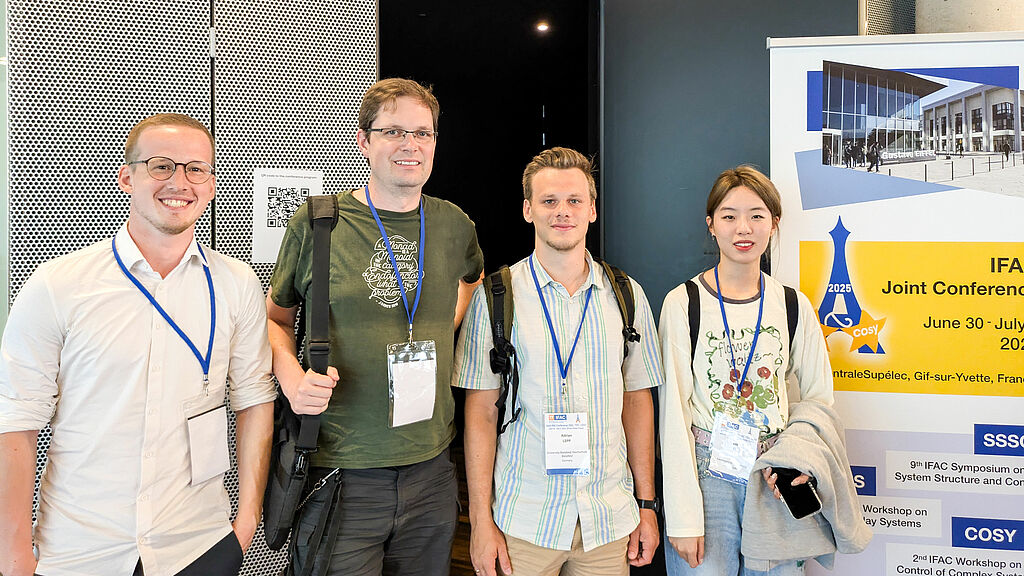

inIT was represented several times at this year's 9th IFAC Symposium on System Structure and Control (SSSC) in Paris: inIT board member Prof. Dr. Markus Lange-Hegermann organised a session at the international symposium together with two colleagues and presented a total of three papers with his team at the Université Paris-Saclay.
Professional exchange on the international stage
The SSSC took place at the end of June 2025 at one of Europe's leading research universities, the Université Paris-Saclay. With 171 accepted papers and an international audience of experts, the event provided an important platform for exchange on current developments in the modelling, analysis and control of dynamic systems.
Special session on computer algebra and control theory
Prof. Dr. Markus Lange-Hegermann, together with Prof. Dr. Daniel Robertz (RWTH Aachen) and Prof. Dr. Thomas Cluzeau (Université de Limoges), organised a special session on ‘Computer Algebra and Control Theory’. Among other things, the session highlighted the use of symbolic computation methods for modelling, analysing and controlling complex dynamic systems – an approach that is increasingly being supplemented by machine learning techniques.
Three papers from inIT
In addition to the session, Markus Lange-Hegermann contributed three papers to the scientific programme – two from his inIT working group ‘Mathematics and Data Science’ and another from an external collaboration:
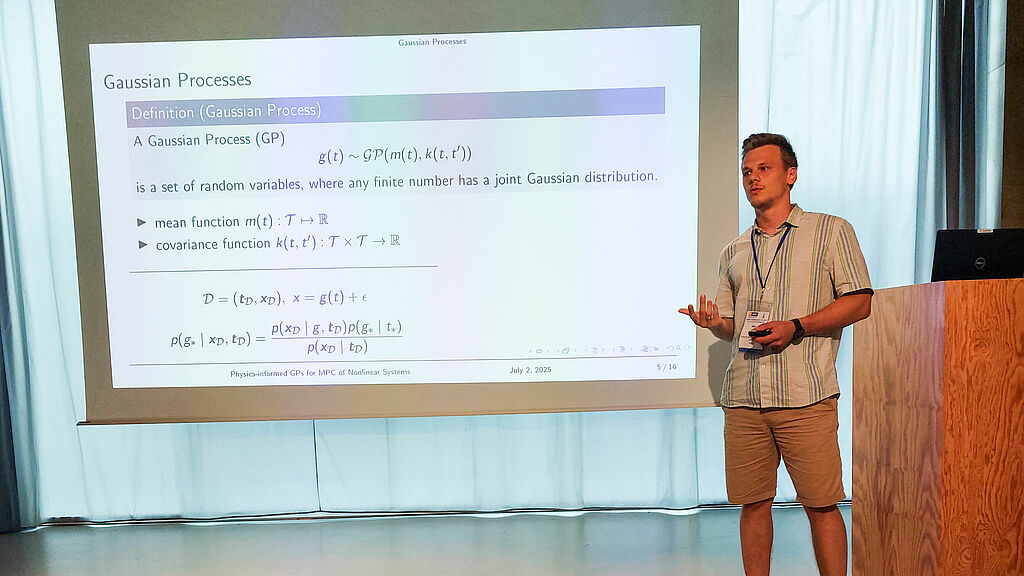
‘Physics-informed Gaussian Processes for Model Predictive Control of Nonlinear Systems’ Adrian Lepp, Jörn Tebbe, Andreas Besginow
Adrian Lepp, a master's student from the supervising working group, presented the joint paper on model predictive control of nonlinear systems at his first conference. The approach uses physics-informed Gaussian processes and is based on a linear approximation around equilibrium points.
To the paper:arxiv.org/abs/2504.21377
‘Linear Ordinary Differential Equations Constrained Gaussian Processes for Solving Optimal Control Problems’ Andreas Besginow, Markus Lange-Hegermann, Jörn Tebbe
Prof. Dr. Markus Lange-Hegermann presented a paper co-authored with Andreas Besginow and Jörn Tebbe from his working group. It presents a computational symbolic approach to solving optimal control problems using Gaussian processes.
To the paper: arxiv.org/abs/2504.12775
‘Gaussian Process Regression for Inverse Problems in Linear PDEs’ Xin Li, Markus Lange-Hegermann, Bogdan Raiţă
External doctoral student Xin Li (Georgetown University) presented a joint paper with her doctoral supervisor Prof. Dr. Bogdan Raiţă and her advisor Prof. Dr. Markus Lange-Hegermann. The paper deals with the solution of inverse problems in linear PDEs using Gaussian processes.
To the paper:arxiv.org/abs/2502.04276
All three papers met with great interest among the participants. The approaches presented exemplify how computer-aided algebra, statistical modelling and control theory can be effectively combined.
Exchange in a summer atmosphere
In addition to the technical impulses, the supporting programme also offered opportunities for personal exchange – for example, at the joint gala dinner on the Seine. Despite summer temperatures of over 40 degrees Celsius, there was lively dialogue on current issues relating to the structure, modelling and control of dynamic systems.
‘The event provided an ideal setting for exciting exchanges – both professional and personal,’ said Prof. Dr. Markus Lange-Hegermann. ‘I am particularly pleased that I was able to involve young scientists such as my master's student Adrian Lepp and give him his first insights into the international research community.’