

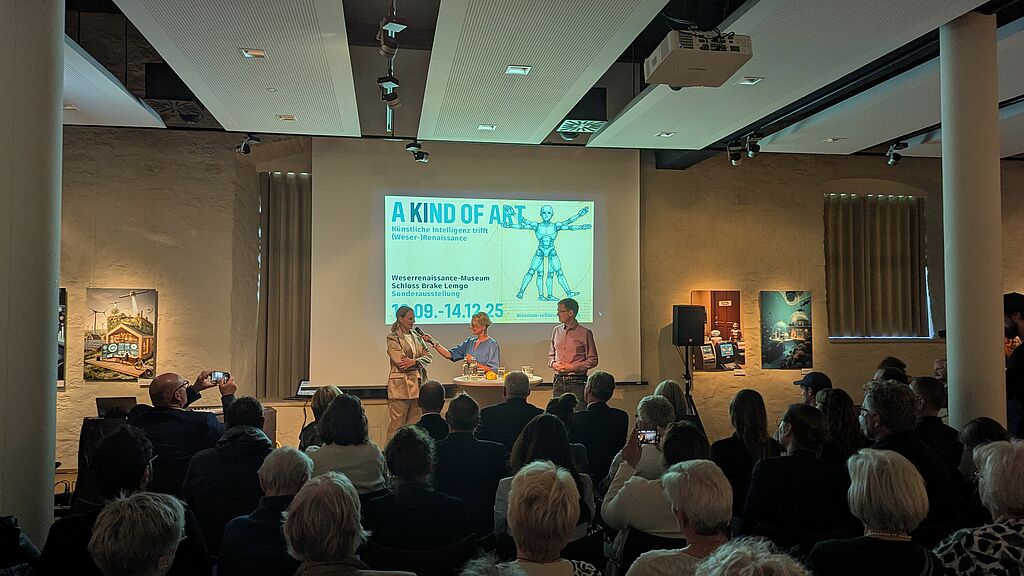
How do the Renaissance era and modern Artificial Intelligence (AI) fit together? The Weser Renaissance Museum Schloss Brake provides exciting answers to this question. On 14 September 2025, the special exhibition "A KInd of Art. Artificial Intelligence meets (Weser) Renaissance" was officially opened. Around 140 guests attended the premiere, including Prof. Dr. Markus Lange-Hegermann from Institute Industrial IT (inIT), Lemgo's mayor Markus Baier and Jörg Düning-Gast, Chairman of the Lippe Regional Association.
Varied ceremony
The opening of the exhibition was not only an official ceremony, but also a varied experience. In addition to musical contributions, which created a special atmosphere, there were also panel discussions involving science, politics and culture. They discussed the fact that Artificial Intelligence is not just a technical topic, but also has social, artistic and ethical dimensions.
Highlights of the AI exhibition
There are numerous highlights in the exhibition itself: From Leonardo da Vinci's recreated "robot knight" to art-historical originals and newly developed AI sculptures generated from historical exhibits. These originate from a project by the Media Production department at Technische Hochschule OWL (TH OWL). The hands-on stations that inIT helped to design are particularly popular: A photo box transforms portraits into Renaissance artworks using style transfer, an ergometer playfully shows how much energy AI queries consume, and an AI telephone provides spoken answers directly via the telephone receiver after a short "pause for thought".
Radiance of the Weser Renaissance Museum Schloss Brake
The show is part of a broad-based cooperation project with partners such as the TH OWL, including the Institute Industrial IT (inIT) and the KreativInstitut.OWL (KIO), the Fraunhofer IOSB-INA and other institutions. The special exhibition, which runs until 14 December 2025, is supported by the state of NRW, the Lippe regional association and regional sponsors.
"With this special exhibition, we want to show how innovative museums can be," emphasises museum director Silvia Herrmann. "The combination of past, present and future encourages reflection and discussion - and opens up completely new perspectives."