

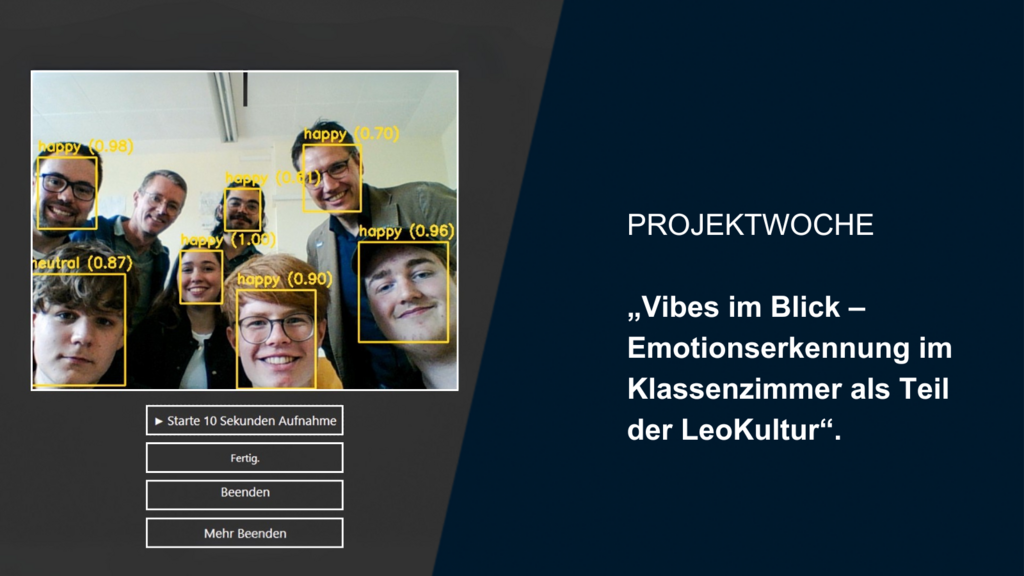
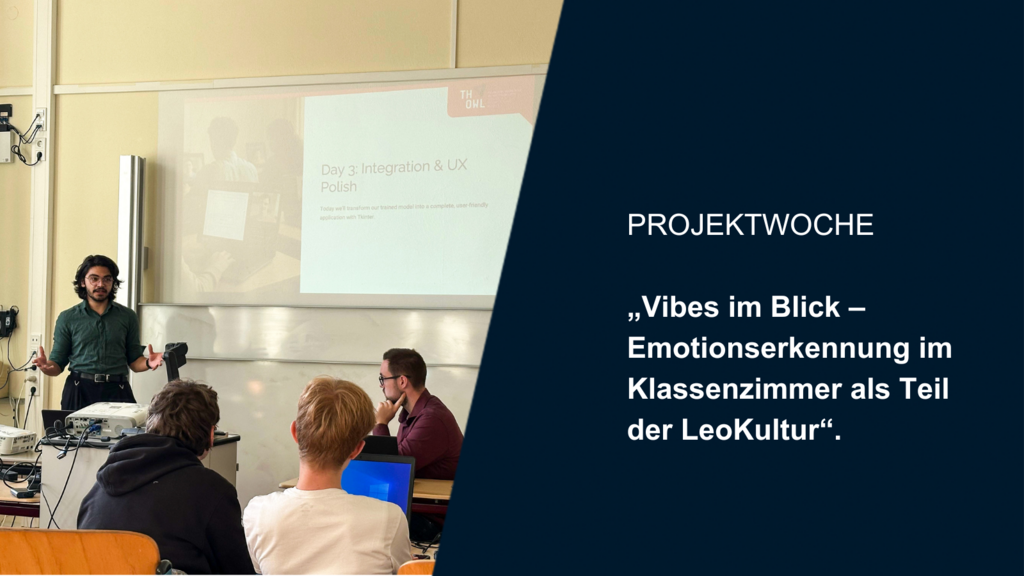
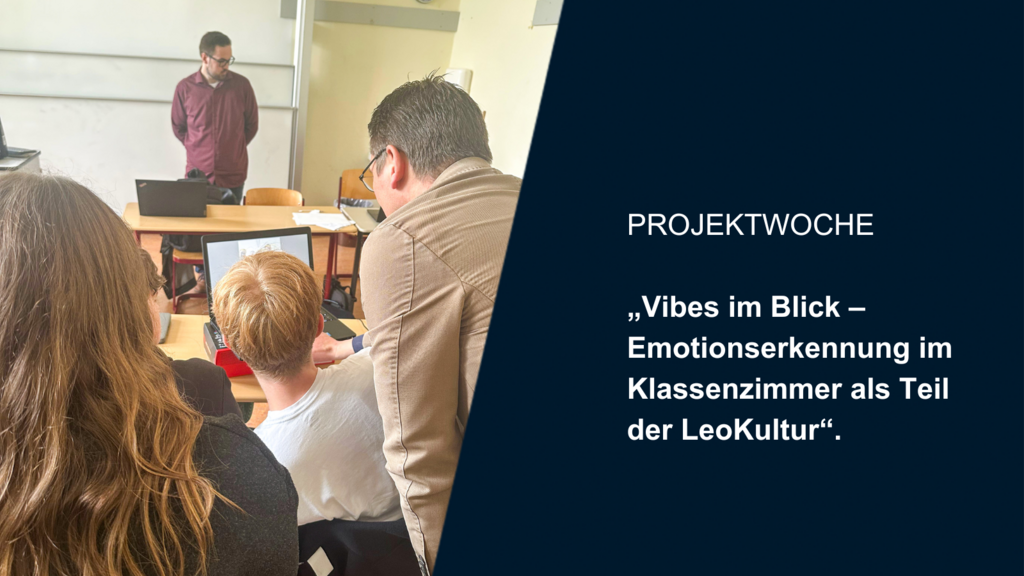
As part of a project week at Leopoldinum Grammar School, pupils worked with the Institute Industrial IT (inIT), the Institute for Energy Research (iFE) and students from the General Engineering bachelor's programme at Technische Hochschule Ostwestfalen-Lippe (TH OWL) to develop their own emotion recognition application. The project was entitled ‘Vibes at a glance – emotion recognition in the classroom as part of LeoKultur’.
It was based on a student project by Mert Bayca and Nehir Yilmaz, two international students in their second semester of General Engineering. They both supported the school project by providing technical input and helping the pupils to implement it.
Programming with Python
To kick things off, the participants learned the basics of programming with Python – including variables, loops and logical conditions. They put their new knowledge into practice right away on laptops provided for them.
Understanding and classifying AI – technically and ethically
The second day of the project focused on artificial intelligence: Robin Foster, research assistant in the inIT working group ‘Networked Automation Systems’ headed by Prof. Dr. Henning Trsek, presented various AI approaches and raised awareness of ethical aspects in dealing with AI. The aim was to understand the necessary steps for AI-supported image recognition. By the end of the day, the pupils were already able to train their own model to recognise and classify emotions in faces.
‘It was great fun to implement emotion recognition together with the pupils. When you try out AI yourself, you understand it better – and learn how to use it responsibly. It was a fantastic project week!’ summarised Robin Foster.
From model to application
The final project day focused on designing a user interface (UI). The pupils were tasked with integrating their trained AI model into an accessible application and developing a simple visual interface to display the results of the emotion classification. At the end, they presented their applications in short presentations.
Fostering curiosity, bringing technology to life
Prof. Dr. Henning Trsek, supervisor of the joint project, was enthusiastic about the collaboration and commitment of all those involved:
‘It is important to us to lower the entry threshold for a complex topic such as AI and to serve as a motivator. We want to spark curiosity and convey to the pupils the fun of working with forward-looking technologies.’