

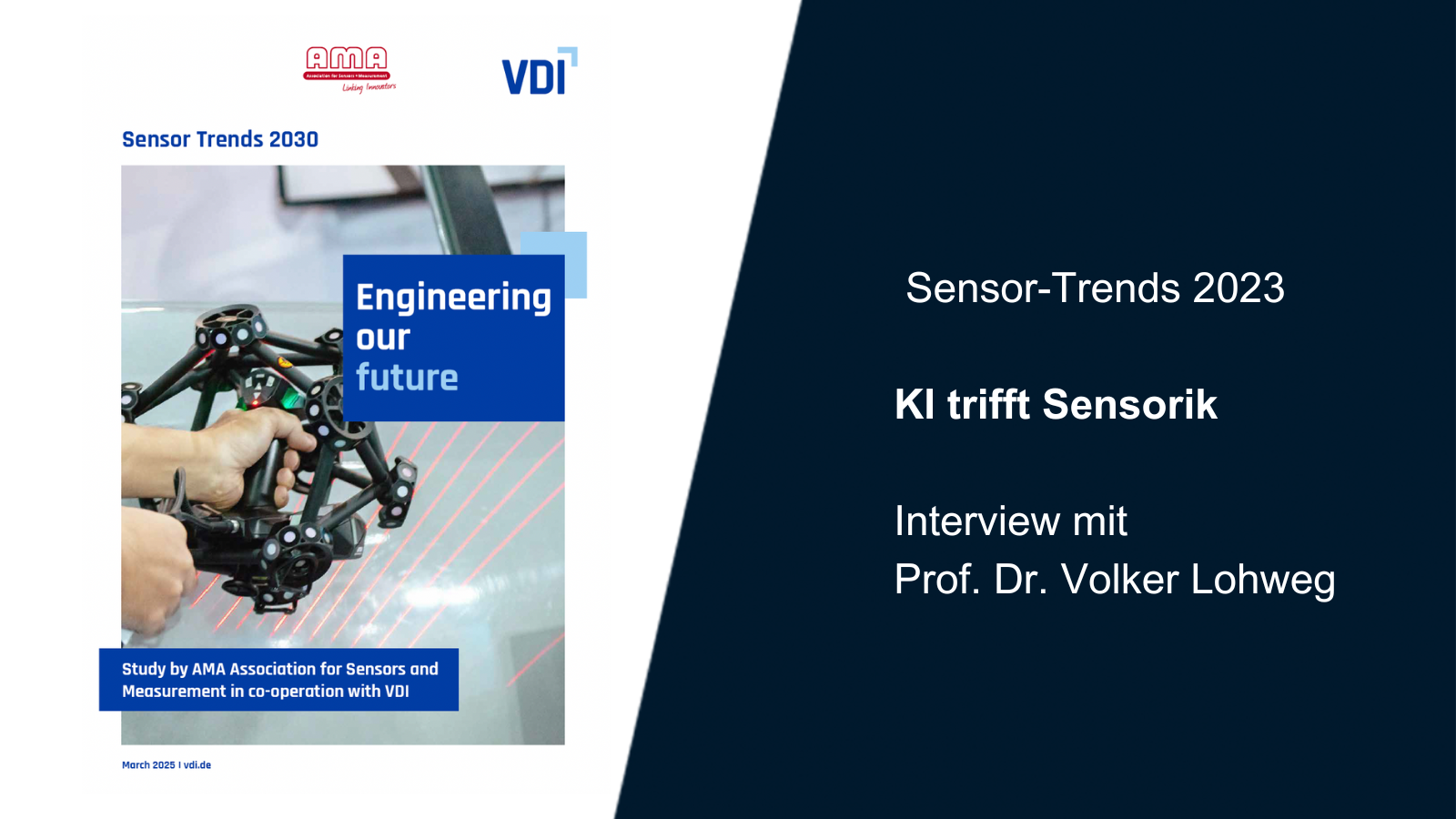
As one of the authors of the study “Sensor Trends 2030” by the AMA Association for Sensor and Measurement Technology and the VDI, Prof. Dr. Volker Lohweg is a sought-after expert on the subject of artificial intelligence (AI) and sensor technology. The study features experts in research and development analysing key developments and challenges in sensor technology up to 2030. Prof. Lohweg was also interviewed by Springer Professional for an article entitled 'Sensors of the future deliver decisions instead of measured values', in which he shared his thoughts on the latest developments in sensor technology.
AI evaluates sensor data
For quite some time now, sensor data has been able to be evaluated with the help of AI. However, this evaluation is associated with latency times. Combining AI and sensors in a single unit, often even on a single chip, opens up completely new possibilities. The advantages of real-time responses are obvious: cost reductions, energy savings, and data security.
Crucial milliseconds
According to Prof. Dr. Lohweg, head of the Discrete Systems research group, fractions of a second can be crucial in preventing critical situations, given that predictive maintenance is becoming increasingly time-critical. “Predictive maintenance is evolving into preventive maintenance,” he summarises.
Higher costs – greater benefits
Integrating additional computing power into sensors incurs higher costs. However, according to Prof. Dr. Volker Lohweg, the advantage of intelligent sensors over conventional ones outweighs this due to their higher and more reliable performance, especially as the new sensors can be manufactured at increasingly lower costs. Like other experts, Lohweg sees great potential for these sensors in production machines, control systems and highly automated production lines, as well as in safety-critical applications such as robotics, medical technology and transportation systems.
Link to the interview by Springer Professional:https://www.springerprofessional.de/sensorik/kuenstliche-intelligenz/sensoren-der-zukunft-liefern-entscheidungen-statt-messwerte/51539360
The study “Sensor Trends 2030” by the AMA Association for Sensor and Measurement Technology and the VDI can be ordered free of charge here:https://sensortrends.ama-sensorik.de/