

How can AI specifically support healthcare?
Dr. Laura Moradbakhti is investigating this question as a practice postdoc at inIT as part of PROFuture in cooperation with the district of Lippe. Her focus is on health informatics. The aim is to develop AI-supported digital assistance systems that meet the actual needs of the healthcare sector – from patients and medical professionals to family caregivers.
In the following interview, Dr. Laura Moradbakhti talks about her role as a postdoctoral researcher, her research focus, and her close collaboration with practitioners.
What personally attracted you to working at the interface between research and practice?
Laura Moradbakhti: In my field of research in particular, it is especially important that research results are not only recorded in publications, but can also be put into practice. That is why I have often worked at the interface between research and practice in my career to date. Close cooperation with the Lippe Health Department enables me to apply my research directly where AI innovations can create the greatest added value.
How would you explain to someone in one sentence what you do in your role as a practical postdoc?
Laura Moradbakhti: I am researching how AI and digital assistance systems can be used in the healthcare sector to meet the needs of various stakeholders—patients, physicians, and family caregivers.
What added value does the 50/50 split between TH OWL and the district of Lippe bring?
Laura Moradbakhti: I benefit greatly from dividing my working day between TH OWL, the district of Lippe, and the health centers in Oerlinghausen and Lügde. Through my cooperation with the health department, I have direct contact with the people who are to benefit from the innovations. This allows me to identify needs at an early stage and determine where my research can be applied in concrete terms.
What topics in the field of health informatics are currently the focus of attention and what would you like to focus on in the future?
Laura Moradbakhti: For me, it is particularly important to conduct research together with the people affected. Co-design workshops, focus groups, and other participatory approaches play a central role in my everyday research. In addition, it is important to promote health literacy and the use of new technologies among the population so that they can be used effectively in the long term. Ethical considerations are also very important when using AI in healthcare.
Looking ahead to the coming months, what are the next steps and what are you particularly looking forward to?
Laura Moradbakhti:I am looking forward to creating tangible added value with my research. As in the rest of Germany, the population in the district of Lippe is aging, while at the same time there are bottlenecks in medical care, for example due to a shortage of skilled workers. AI can help to close gaps in care and enable new approaches to healthcare for the population.
Health informatics as a strategic link
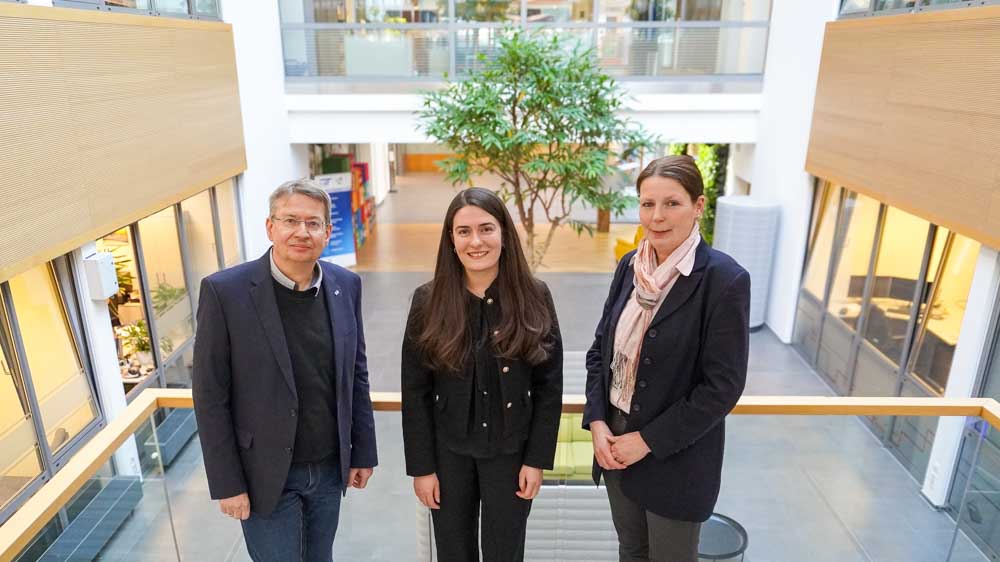
Recently, Dr. Laura Moradbakhti, Prof. Dr. Volker Lohweg — head of the Discrete Systems research group, to which Dr. Laura Moradbakhti is affiliated at inIT — and Dr. Kerstin Ahaus, head of the Lippe District Health Office, came together to plan and jointly develop the next steps in their cooperation.
The collaboration between inIT and the district of Lippe thrives on close exchange and a shared commitment to combining research and practice at an early stage and in a targeted manner.
“With Laura Moradbakhti, we are gaining a scientist who combines professional depth with a keen understanding of practical issues. This combination will contribute significantly to the joint development of the field of health informatics,” emphasizes Prof. Dr. Volker Lohweg.
Dr. Kerstin Ahaus is also delighted about the collaboration:
“The cooperation enables us to conceive and develop new technological approaches together with the university. For us, this is a real benefit for the future direction of healthcare.”
Find out more about the district of Lippe: http://www.kreis-lippe.de/kreis-lippe/index.php
Learn more about PROFuture: https://www.th-owl.de/profuture/kooperationen/#c-accordion-94772-2