

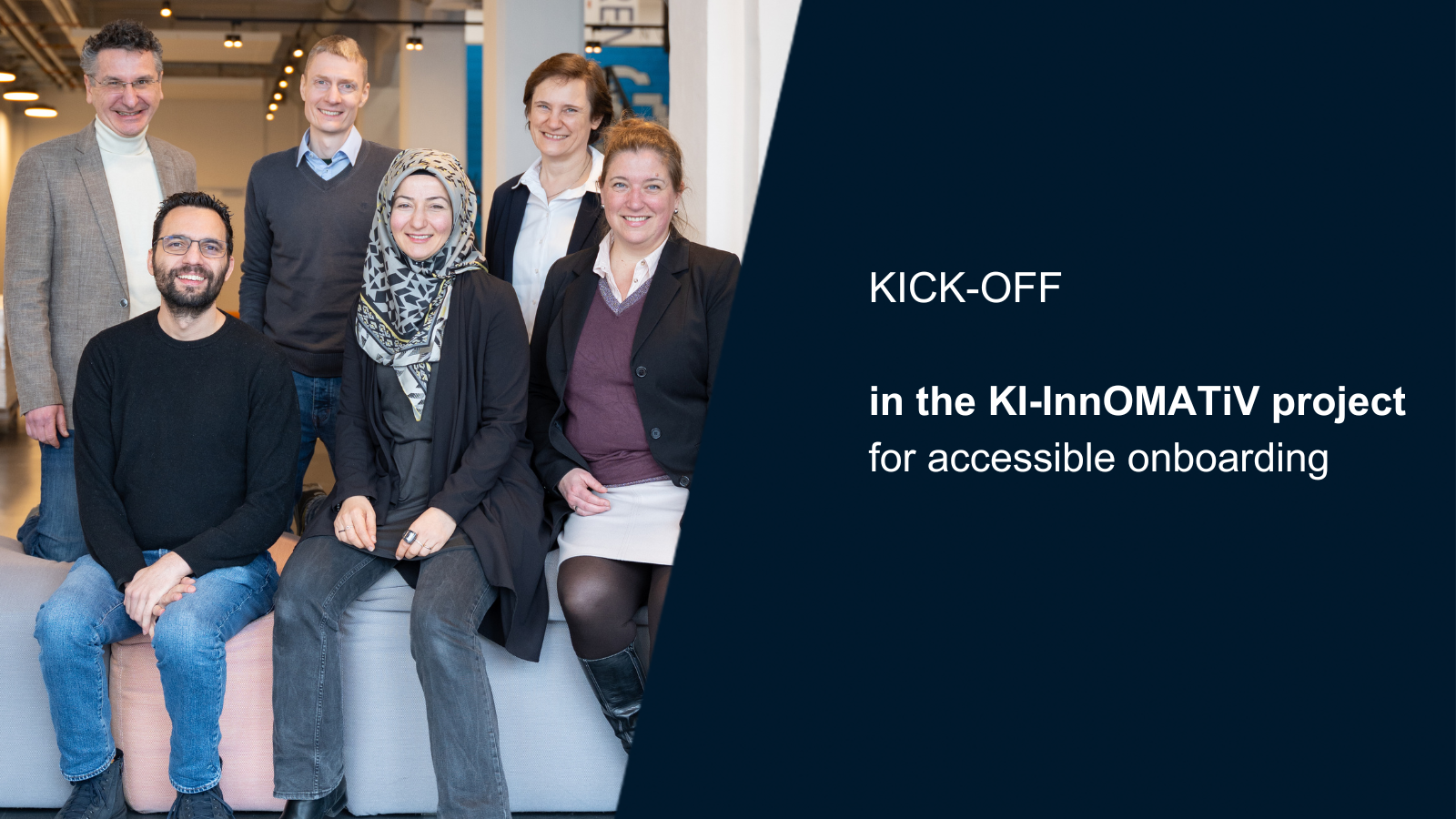
AI-InnOMATiV: AI-powered onboarding for inclusive public administrations
KI-InnOMATiV is a collaborative project aimed at developing and testing an AI-powered assistance system for inclusive onboarding in public administrations. The project focuses on mixed-ability teams, accessible design, practical integration into existing systems, and responsible AI guidelines regarding data protection, IT security, and transparency.
AI-InnOMATiV is a research and development project designed to facilitate the onboarding of new employees in public administrations, particularly in settings where people with varying support needs work together. In collaboration with industry partners, the project is developing an intelligent onboarding assistance system that clearly organizes information, roles, and work steps, provides situational support in daily work, and thereby breaks down barriers.
Onboarding as the Key to Successful Collaboration
Effective onboarding involves more than just imparting technical knowledge and processes. It’s also about providing guidance, fostering a sense of security, and ensuring successful collaboration. New employees bring diverse backgrounds, strengths, and learning styles to the table. At the same time, teams, leadership, and key contacts shape the onboarding experience through clear expectations, reliable communication, and appropriate support. AI-InnOMATiV therefore deliberately focuses on the needs of the target groups and develops solutions that not only help individual groups but also make the onboarding process easier for everyone by improving clarity, structure, and fit in the day-to-day work environment.
Challenges in Public Administration
Public administrations face a twofold challenge when it comes to onboarding: many processes are complex, knowledge is scattered across different departments, and the IT landscape has often evolved over time. At the same time, onboarding must be accessible, tailored to the target audience, and practical. KI-InnOMATiV views onboarding as a continuous process, from initial orientation through on-the-job learning to the confident execution of recurring tasks.
AI assistance in the workplace
To this end, the project combines several technical components: An intelligent assistant answers questions and guides users through the steps. In addition, the system is linked to existing learning and knowledge resources. To provide support exactly when it is needed, typical workflows are analyzed within a specific web-based administrative system. Based on this, the system can offer relevant guidance directly within the work context, for example as brief explanations or on-screen highlights.
Accessibility as a key quality criterion
Accessibility is a key quality criterion. From the very beginning, the interface and operation of the assistance system are designed to be easy to use even under varying conditions. Established standards serve as a guide in this process. To ensure that the solutions truly work in everyday life, they are tested in multiple development cycles in collaboration with users and gradually improved.
Developed in collaboration with the field
To this end, the project combines needs assessment, collaborative design, and technical development. Within government agencies, work contexts and typical entry paths are analyzed to identify specific requirements. Based on this, prototypes are created and tested in realistic situations. The results are used not only to develop software modules but also to create materials that facilitate implementation, such as guidelines, training programs, and frameworks for transferring the solutions to other areas.
Integration with existing systems
The solution should be designed so that it can be integrated into various web-based administrative applications. This will ensure that government agencies are not dependent on a single system, but can gradually incorporate the assistance system into their existing work environments. To ensure successful implementation in practice, easy-to-use supporting materials, such as guides and training courses, will be developed.
Data Protection and Responsible AI
Data protection and responsible use are not simply “added on” as an afterthought, but are integrated from the very beginning. The project is developing its own data protection framework, emphasizing data minimization and clear rules for handling sensitive content. Furthermore, it should always be clear when the system makes a recommendation and how that recommendation can be verified in a work context.
Work packages of inIT
The project is based at the Institute Industrial IT (inIT) at TH OWL under the supervision of Prof. Dr. Jessica Rubart. The inIT contributes its expertise in the field of intelligent information systems and human-machine interaction. This includes, in particular, methods from process mining, large language models, and approaches to explainable artificial intelligence, which are used to analyze workflows in administrative systems and provide context-aware support for new employees.
The project will run for 36 months and is funded under the ERDF/JTF Program NRW 2021–2027 | NEXT.IN.NRW.
Consortium partners
- Ruhr West University of Applied Sciences (HRW): Consortium coordination, human-centered technology development, UX/accessibility, scientific support.
- North Rhine-Westphalia University of Police and Public Administration (HSPV NRW): Administrative context, field access, transfer to practice and training.
- Dortmund Technical University (TU): Research on participation/work, evaluation of inclusive impacts.
- Ostwestfalen-Lippe University of Applied Sciences (TH OWL) | Institute Industrial IT (inIT): AI-supported information systems, process mining, large language models, explainable AI.
- fabbrain Software GmbH: Software development and integration.
- Adnexxus GmbH: System architecture, data protection/IT security.
