

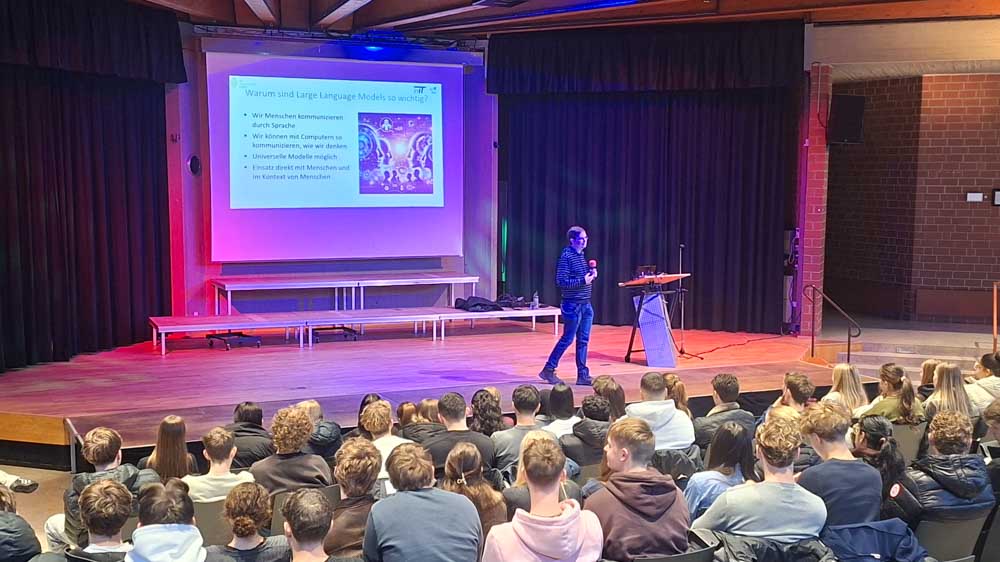
How can artificial intelligence support learning—and what are its limitations? Dr. Claus Hilbing, headmaster of the school, introduces the event. Students at Grabbe Gymnasium explored these questions together with Prof. Dr. Markus Lange-Hegermann (inIT). The professor of mathematics and data science visited Grabbe Gymnasium to discuss the opportunities, risks, and sensible use of AI openly with young people.
Prof. Dr. Markus Lange-Hegermann focuses intensively on the use of AI in his teaching. Together with students, he develops individual learning environments designed to support learning processes. To broaden this perspective, he deliberately sought dialogue with school students: How are young people already using AI today? What expectations do they have of AI in school, university, and work?
The event focused on fundamental questions: What are neural networks? How does AI actually work? Clear examples showed that AI is powerful, but it does not “think” or act creatively; rather, it is based on the evaluation of large amounts of data. Critical reflection was given to why ChatGPT is often better at writing texts than performing mathematical calculations, what AI cannot do, and why incorrect data can lead to absurd results.
Ethical and social aspects were also openly discussed: facial recognition, automated data collection, data protection, energy and water consumption of data centers, and the question of who actually owns AI. The risks of disinformation, propaganda, manipulated images, and videos on social media platforms were also discussed intensively. Another topic was the potential for cultural homogenization, as many AI models operate globally and originate in the US or China.
One focus was on the school of the future: Do students still need to learn everything when AI seems to be capable of doing everything? The young people clearly spoke out in favor of not banning AI, but rather learning how to use it competently. In a spontaneous vote, the majority voted in favor of frequent use of AI in the classroom, with no one voting for a complete ban.
The use of AI in exams and tests was controversially discussed. While many emphasized that exams should primarily reveal one's own knowledge, the idea of further developing exam formats was also taken up: more complex tasks, new questions, and the reflective use of AI as part of the performance.
At the same time, the question of educational equality arose: if powerful AI costs money, will this create new inequalities? The students tended to see the advantages, because it is accessible to everyone – but they also noted that the expensive paid versions could do more.
The event made it clear that AI can be a helpful tool if young people learn to use it critically, responsibly, and competently. The cooperation between TH OWL and Grabbe Gymnasium aims to continue this dialogue and create space for further joint projects.