

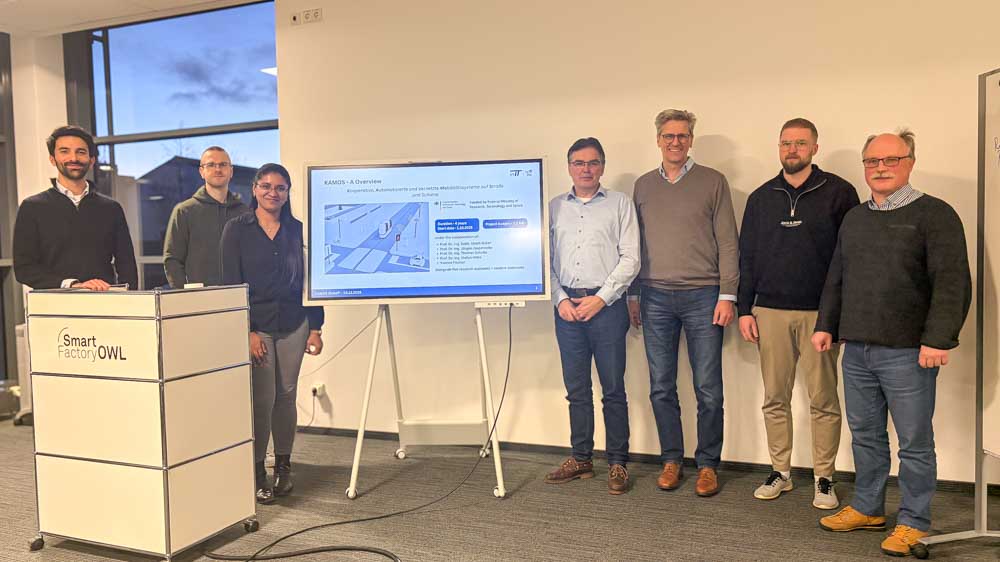
The KAMOS research project – Cooperative, Automated, and Networked Mobility Systems on Road and Rail – has begun its substantive work with an initial internal workshop. The four-year project marks a significant technological expansion of the Innovation Campus Lemgo and creates new research and testing areas for the mobility of the future.
KAMOS: Cooperation between inIT, iFE, and partners from science and industry
KAMOS is being implemented as a joint initiative of the Institute Industrial IT (inIT) and the Institute for Energy Research (iFE) together with partners from research and industry. The kick-off workshop was attended by the professors involved in the project, Prof. Dr. Ulrich Büker, Prof. Dr. Jürgen Jasperneite, and Prof. Dr. Thomas Schulte, as well as current and future research assistants.
The aim of the KAMOS project is to systematically investigate and further develop the cooperative interaction of different road users, including automated and non-automated vehicles, rail transport, cyclists, and pedestrians. To this end, real-world test scenarios are combined with digital simulations to test new concepts for safe, efficient, and connected mobility.
At the Innovation Campus Lemgo, an intelligent intersection with all the necessary technical equipment is being built in connection with the MonoCab campus train.
Brainstorming and shared understanding as a basis
The workshop served as the kick-off for the initial idea and conception phase. Initial use cases, research questions, and technical focal points were discussed in interdisciplinary rounds. The aim was to develop a common understanding of the project goals and lay the foundations for further cooperation.
At the start of the project, Prof. Dr. Ulrich Büker emphasized:
“KAMOS offers us the opportunity to consider and explore automated and non-automated road users together in realistic scenarios – this is a real added value for research, teaching, and transfer.”
Networked perspectives right from the start
Particular emphasis was placed on establishing early networking between the disciplines and working groups involved. Strategic and technical exchange is crucial in this early phase in order to develop viable technical concepts and interfaces.
“KAMOS will create a powerful infrastructure for the exciting field of networked mobility at the Innovation Campus Lemgo, which will primarily benefit students of computer science and electrical engineering as well as doctoral candidates,” explains Prof. Dr. Jürgen Jasperneite.
Next steps in the KAMOS project
KAMOS is supported by several working groups at inIT and combines expertise in automation, communication technology, and mobility systems. The actual project kick-off with the participating partners is scheduled for early March.