

ZukunftsClub OWL - a joint further education project
The digital revolution is affecting all areas of daily life. Not everyone is able to keep pace with this rapid development. This is precisely where the "ZukunftsClub OWL" comes in, a joint further education project of the Lippe adult education centres and the Technische Hochschule Ostwestfalen-Lippe (TH OWL), represented by the Institute for Scientific Dialogue (IWD). The ZukunftsClub OWL is an initiative that aims to communicate modern technology in an understandable and practical way and is actively supported by inIT.
Making digitalisation tangible
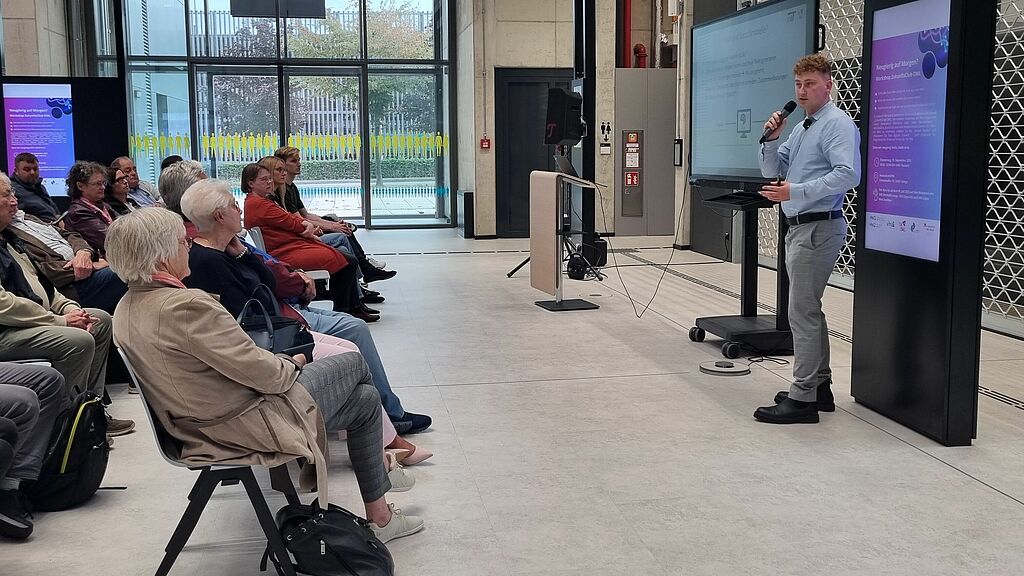
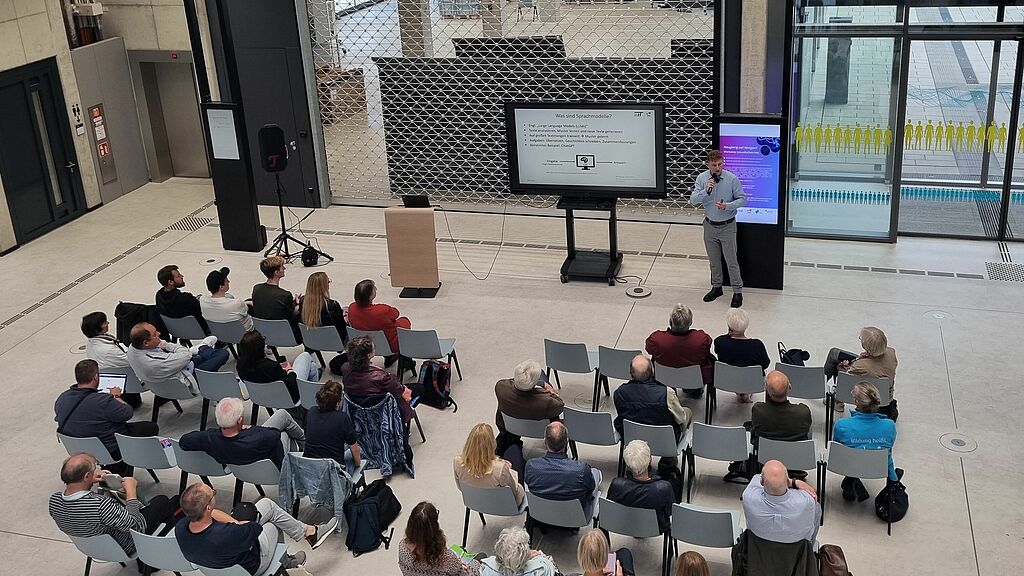
Against this backdrop, a workshop on the topic of "Making digitalisation tangible" was held at InnovationSPIN on 18 September 2025. One area of the workshop was dedicated entirely to the topic of Artificial Intelligence (AI) in the context of medical and healthcare technology. Patrick Gaudl, research associate in the "Discrete Systems" working group headed by Prof. Dr. Volker Lohweg, contributed his expertise in this field at the invitation of IWD.
Lecture on Large Language Models
Artificial Intelligence - and Large Language Models (LLMs) in particular - are increasingly finding their way into medicine. While some headlines proclaim AI as a "career killer for doctors", many people are already using chatbots such as ChatGPT as personal health advisors. This makes it all the more important to clearly communicate both the opportunities and risks of this technology. In his lecture "Doctor AI? How are language models changing medicine?", Patrick Gaudl explained to the 30 attendees how LLMs work, where their potential lies in medicine and where risks such as hallucinations and misinformation set important limits.
Practical application in the workshop
Patrick Gaudl then tested ChatGPT in practice with the workshop participants and discussed with them whether and how such systems could be suitable as health advisors. One particularly exciting example was RAGLE-PD, a Parkinson's information system developed by Dr. Andreas Becker. Dr. Andreas Becker is Medical Director and Chief Physician of Neurology at the SRH Kurpfalzkrankenhaus in Heidelberg. It combines LLMs with validated expert knowledge and relies on Retrieval Augmented Generation (RAG). The decisive advantage: the AI shows the sources of its answers, which creates transparency and enables verification.
The attendees told the inIT researcher that they had gained both a clearer view and a more critical approach to LLMs from the illustrative presentation and, above all, from trying them out in practice.
Potential of language models in medicine
From Patrick Gaudl's point of view, language models are not career killers for doctors, but rather valuable helpers if they are used responsibly and in the right context. His conclusion: "Language models hold enormous potential for medical applications, but they also bring challenges that must be addressed."