

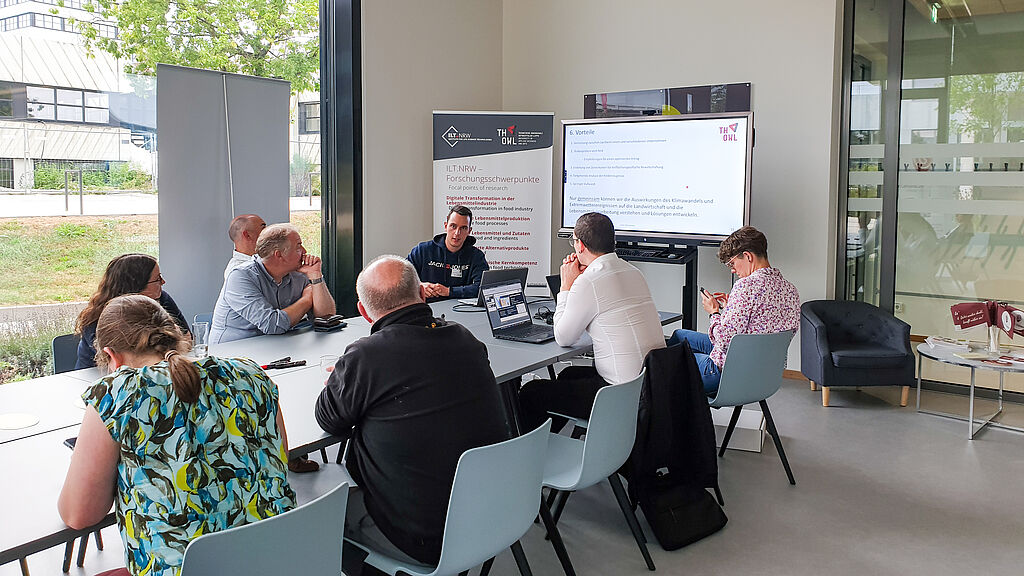
How digital technologies can strengthen regional value creation: At the REGIOtalk workshop, 'Stadt.Land.Wirtschaft in Ostwestfalen-Lippe', held at the Future Food Factory OWL on 4 September 2025, numerous stakeholders from business, science, and administration exchanged ideas on new approaches to regional food production. inIT was also represented with a contribution from research group leader Natalia Moriz and research associate Philip Sehr from the Interconnected Automation Systems working group headed by Prof. Dr. Henning Trsek.
Shaping regional value creation together
The event was held in cooperation with the Landesverband Regionalbewegung NRW e.V. (North Rhine-Westphalia Regional Movement Association) and the district of Lippe. The aim of the workshop was to develop concrete measures for a sustainable and regionally anchored food industry.
As a research and demonstration platform for the digital transformation of food technology, the Future Food Factory OWL provided the ideal setting for exchange between producers, processors, the catering industry, administration and science.
The focus was on the results and ideas from the previous REGIOtalk in February 2025. After keynote speeches on the further development of the regional movement and the planned ‘RegionalMarktOWL’ platform, the participants discussed possible implementation strategies at various themed tables – from financing and promotion to networks and initiatives to innovation and technology.
Digital product passport as an impetus from research
The Innovation & Technology theme table was moderated by Nele Jantz from Future Food Factory OWL.
Philip Sehr and Natalia Moriz presented the Digital Product Passport – a project from the joint partnership smartFoodTechnologyOWL. The concept shows how digital technologies can create transparency along the value chain and promote sustainability.
The approaches presented led to a lively discussion about possible collaborations and application scenarios for regional companies and institutions.
Exchange as the basis for future viability
‘Direct dialogue between research, business and administration is crucial for bringing innovative ideas into practice together,’ emphasises Natalia Moriz. ‘Formats such as REGIOtalk offer exactly the right framework for this – they show how research results can contribute in very concrete ways to the sustainable development of our region.’