

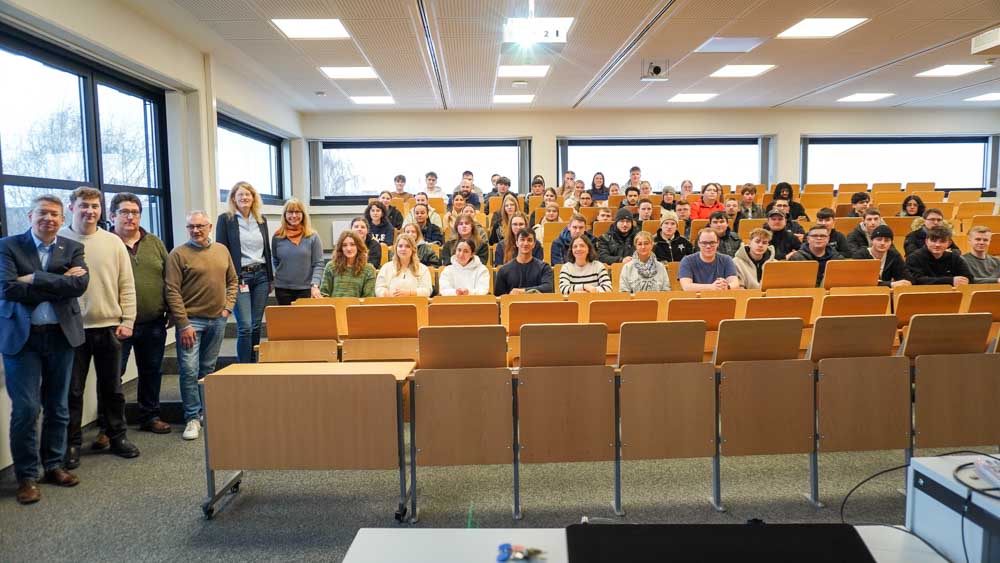
On 05 February 2026, pupils from the vocational grammar school specialising in health and the higher vocational school for electrical engineering assistants at the Lüttfeld vocational college in Lemgo as well as upper school engineering technology pupils from the vocational grammar school and upper school IT assistants from the Felix Fechenbach vocational college in Detmold attended an information event organised by the Institute Industrial IT (inIT) and the Applied Health Sciences (AHS) research focus at the Technische Hochschule OWL (TH OWL).
New field of study: Health Informatics in the Department of Computer Science and Automation
Frauke Wiegräbe, research associate in the Discrete Systems working group, began by welcoming the approximately 50 students and their teachers and introducing the participants to the prepared information programme. Prof. Dr. Volker Lohweg, head of the Discrete Systems working group, then presented the relevant courses offered by the Technische Hochschule OWL in detail. He focused on the "Health Informatics" degree programme, which will be launched in the Department of Computer Science and Automation at TH OWL in the 2026/2027 winter semester. Health informatics develops digital solutions for the healthcare sector, thereby improving medical care for sick people – an approach that met with great interest among those present.
Insights into studying and campus life
Patrick Gaudl, a master's student and also research associate in the Discrete Systems working group, then provided more detailed information about the bachelor's programme in Health Informatics, including specific content such as lectures, exercises, internships, project and research work, and excursions to industry partners. He not only provided vivid insights into everyday student life, but also into student life on campus beyond the "lecture hall".
Patrick Gaudl, himself a former student at Lüttfeld vocational college, also reported on two app developments at inIT that provide support to Parkinson's and stroke patients in the course of their treatment. These developments are being driven forward in cooperation with the University Hospital OWL, Clinic for Neurology and Neurogeriatrics, Chief Physician Prof. Dr. Christoph Redecker, Lippe Hospital and the Parkinson's network PNOWL+.
Pie in the sky or everyday medical practice?
In another block, the pupils were challenged to engage with the latest research findings. Research associate Tatjana Brasu from the Applied Health Sciences research centre reported on the "Pharmaceutical Engineering" study programme, which is headed by Prof. Dr. Gerd Kutz from the Department of Agriculture, Food and Health. She focused in particular on the field of research known as "personalised therapy": "While today all patients with a certain disease receive the same medication, in future they will receive individually tailored drugs that are manufactured specifically for them." This may still sound like "pie in the sky" to the students, but it could soon become normal practice in medicine and healthcare.
Grasping research
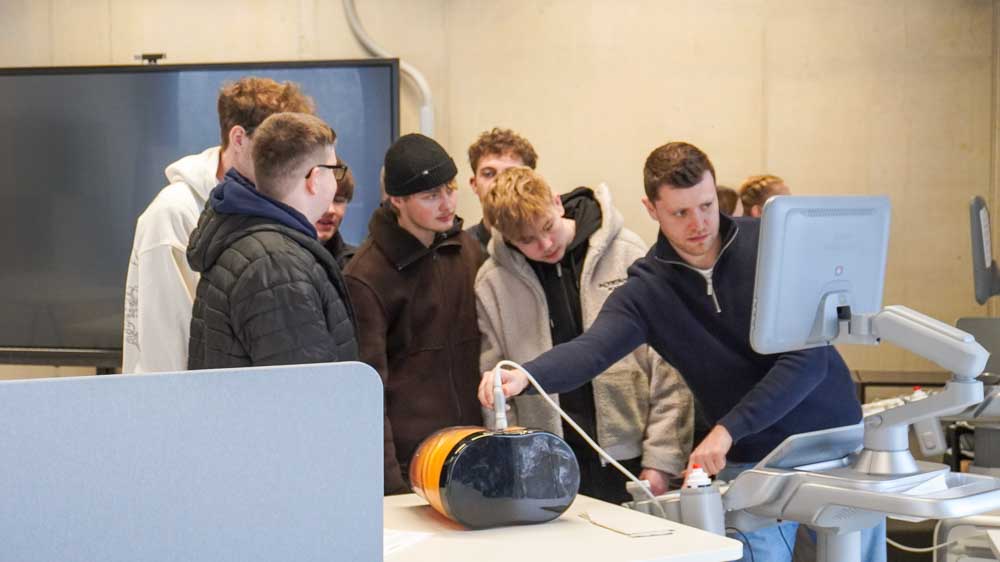
The visitors from the vocational colleges particularly enjoyed being able to get involved themselves. After the presentations, the students tried out various medical technologies, such as an ultrasound device or an EEG measurement system, at InnovationSPIN. Tatjana Brasu informed those interested about the possibilities of the 3D bioplotter for individual medication.
Beneficial work
The information event is much appreciated by vocational colleges and an important building block for students who are considering their future career paths. This reinforces Frauke Wiegräbe's commitment: "On the one hand, it's great fun to interact with young people. On the other hand, they gain beneficial insights into our research and the latest developments in our Campus OWL project ISy-CARE."