

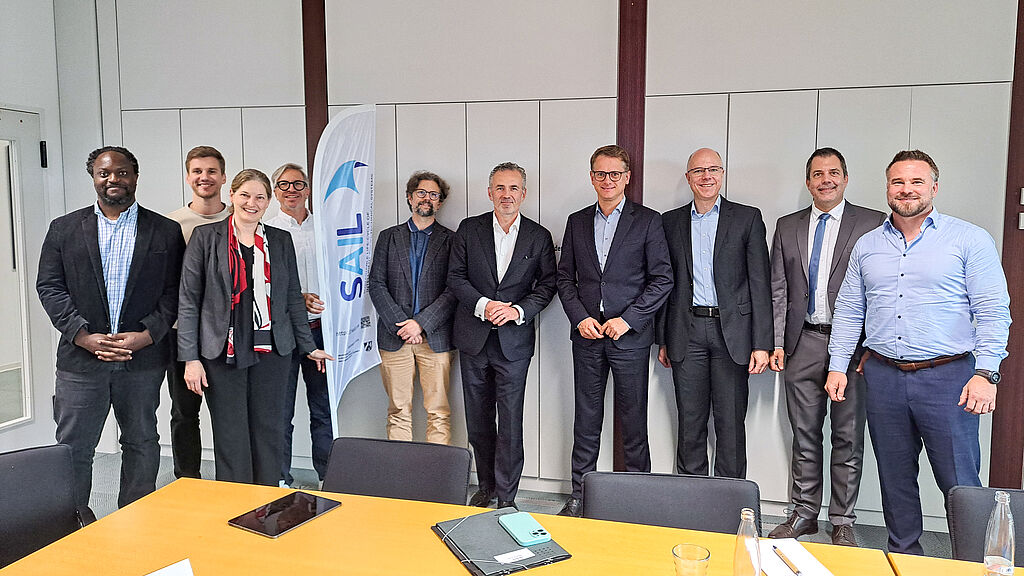

Visit by Dr. Carsten Linnemann and Thomas Jarzombek
How can artificial intelligence (AI) be made reliable, efficient and socially effective?
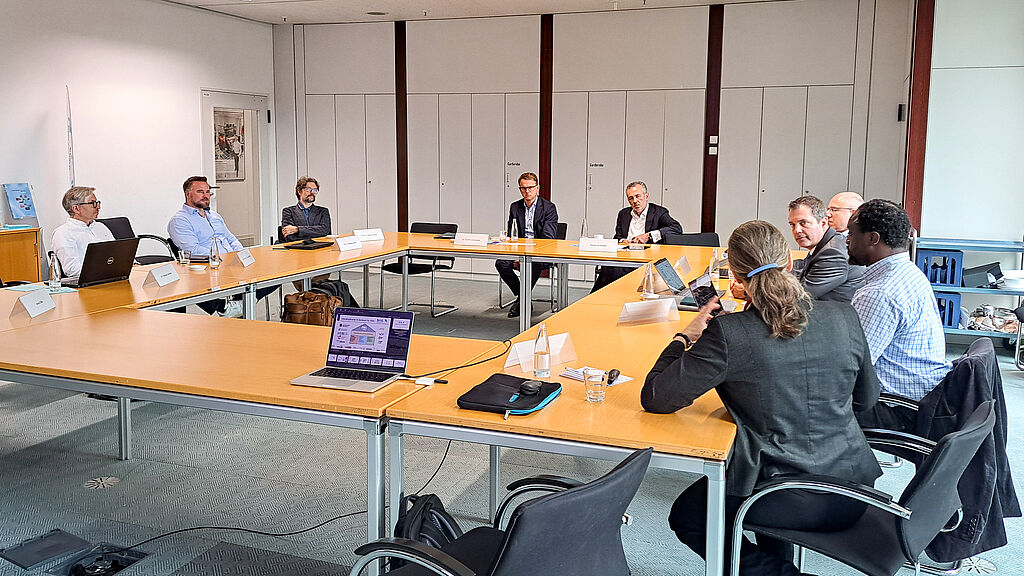
This question was the focus of the visit by Members of the German Bundestag Dr. Carsten Linnemann and Thomas Jarzombek to the Heinz Nixdorf Institute at the University of Paderborn. In an intensive exchange with representatives of the SAIL network, they discussed the needs and potential of sustainable AI in real-world application scenarios.
SAIL project: Interdisciplinary for responsible AI
SAIL (Sustainable Life-Cycle of Intelligent Socio-Technical Systems) is an interdisciplinary research network comprising the universities of Bielefeld and Paderborn, the Bielefeld University of Applied Sciences and Arts (HSBI), and the Technische Hochschule Ostwestfalen-Lippe (TH OWL). The project aims to develop AI systems that are secure, robust and efficient, even under real-world conditions such as limited data volumes, scarce computing resources and high cognitive load.
The project brings together expertise from the fields of core AI research, engineering, and the social sciences. It focuses on the entire life cycle of intelligent socio-technical systems, from their introduction and operation to their long-term use. SAIL therefore distinguishes itself deliberately from mainstream models that are data- and computation-intensive.
Relevance to the economy, health and inclusion
This perspective is particularly important for small and medium-sized enterprises, the healthcare sector, and inclusive technology. In safety-critical or sensitive contexts, AI must be able to function reliably in real-world applications as well as in the laboratory. This is precisely where SAIL comes in.
Prof. Dr. mult. Carsten Röcker emphasises practical relevance and responsibility in AI development
Prof. Dr. mult. Carsten Röcker, member of the inIT board and one of the SAIL project managers, took part in the discussion on behalf of TH OWL. He emphasised:
‘SAIL does not strive for maximum AI performance – but rather for solutions that remain reliable, efficient and understandable and comprehensible in practical use in the long term.’
Constructive exchange with political relevance
The meeting also provided an opportunity to demonstrate the practicality of the research using concrete examples from the two SAIL application areas: 'Intelligent Industrial Work Environments' and 'Adaptive Assistance Systems in Healthcare'. Rather than a traditional exhibition, the focus was on direct interaction and collaborative experimentation.
The MPs showed great interest in the research work and emphasised the social added value of interdisciplinary AI development. We are delighted that SAIL is also gaining recognition at the political level and would like to express our gratitude for the mutually enriching, constructive exchange on the meaningful and responsible use of AI.
Find out more about SAIL:www.sail.nrw