

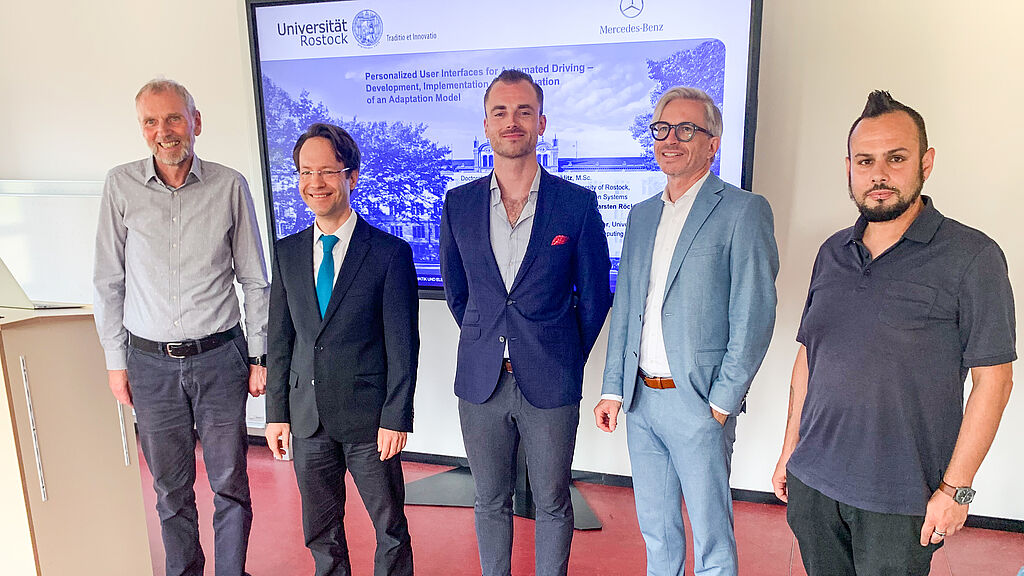
Tim Driesen-Micklitz successfully defended his doctoral thesis, entitled Personalised User Interfaces for Automated Driving: Development, Implementation and Evaluation of an Adaptation Model, at the Faculty of Computer Science and Electrical Engineering at the University of Rostock. From 2020 to 2025, he completed his doctorate as an external doctoral candidate in the Human-Technology Interaction working group at inIT, under the supervision of Prof. Dr. mult. Carsten Röcker. The dissertation was jointly supervised by Prof. Dr. Michael Fellmann from the University of Rostock and was awarded magna cum laude. With the successful defence, he now holds the academic degree of Doctor of Engineering (Dr.-Ing.).
Research into user-centred mobility systems
Automated driving is widely regarded as one of the most significant developments in the automotive industry. It creates new possibilities for using travel time productively or for relaxation. However, safe and intuitive human-machine interaction is essential for this technology to be accepted. The information displayed in the vehicle plays a central role in this.
The aim of Tim Driesen-Micklitz's dissertation was to develop a model that adapts user interfaces individually to the characteristics and experiences of drivers. It was based on two driving simulator studies conducted in close cooperation with Mercedes-Benz AG in Stuttgart. These studies examined differences between users and their information preferences. This resulted in an adaptation model that enables personalised information offerings in the user interface and contributes to improving human-machine interaction.
A subsequent study confirmed the effectiveness of the approach: drivers who used a personalised interface rated the system significantly more positively than a comparison group with a standard interface – especially in terms of safety and comfort. The work thus makes an important contribution to the development of user-centred and trustworthy systems for automated driving.
Scientific exchange and interdisciplinary perspective
The examination board included Prof. Dr. Kurt Sandkuhl, Prof. Dr. Michael Fellmann, Prof. Dr. mult. Carsten Röcker and Prof. Dr. Stefan Bruckner. The defence highlighted the high relevance of interdisciplinary research at the interface of computer science, cognitive science and mobility systems.
‘The thesis illustrates how crucial it is to strike a good balance between technical innovation and user orientation,’ explained Prof. Dr. mult. Carsten Röcker. ‘Only when people trust the systems can technologies such as automated driving truly realise their potential.’