

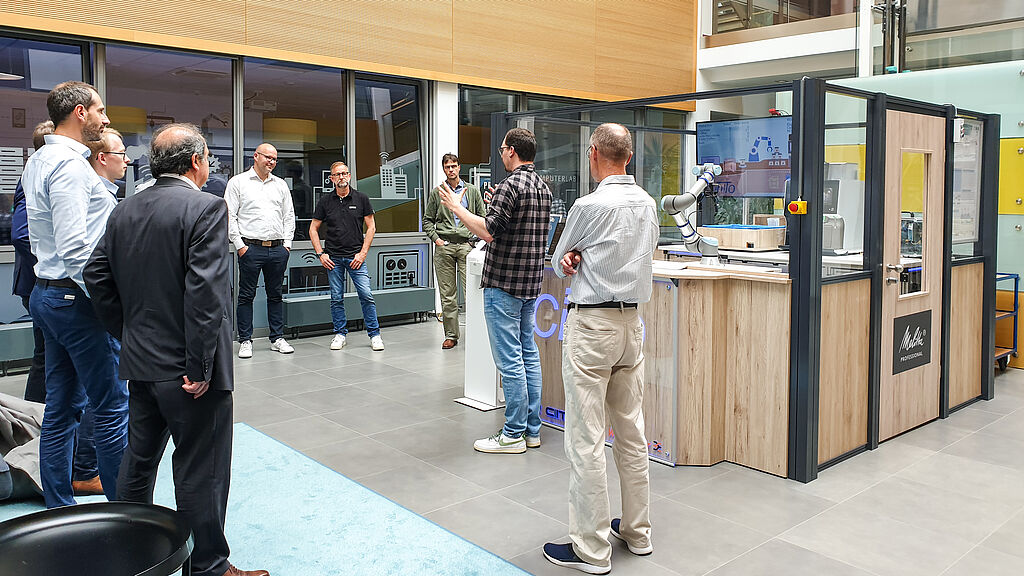
On 5 June, the it's OWL 'Digital Twin' focus group met at the Centrum Industrial IT (CIIT) on the Innovation Campus Lemgo. Experts from academia and industry came together for a workshop focusing on key developments relating to the digital type plate and the digital product passport.
Natalia Moriz (research group leader) and Philip Sehr (research assistant) participated on behalf of inIT. As members of the ‘Interconnected Automation Systems’ working group, headed by Prof. Dr. Henning Trsek, they presented current research results from the ‘DiPP – Digital Product Passport for Secure Information Exchange in the Supply Chain’ (DiPP) project.
The digital type plate: making digitalisation tangible
The ‘Digital Twin’ focus group supports companies in identifying digitisation potential and developing concrete implementation options, particularly through knowledge transfer, workshops, and exchange formats.
The workshop in Lemgo focused on the digital type label as a content component for the digital product passport, which will play a central role in transparent, sustainable and data-driven production processes in the future.
DiPP: Quality assurance through digital evidence
In the DiPP project, inIT is collaborating with partners to explore ways in which automated quality management can be enhanced using digital twins. The aim is to strengthen business relationships between supply chain actors, such as machine manufacturers and operators, by providing tamper-proof quality evidence. In the future, this evidence will also be made available to end consumers via a digital product passport.
In the workshop, Natalia Moriz and Philip Sehr presented specific approaches from the project. They demonstrated how, alongside the digital type plate, data on resource consumption, quality evidence, and interfaces to product functions can be systematically recorded and digitally mapped. Using the inITo demonstrator — a robot-assisted barista — they showed how digital twins can be implemented in practice.
"We were very pleased to welcome the focus group to our Innovation Campus Lemgo. The workshop once again demonstrated the importance of close collaboration between research and industry. This puts practical issues at the centre of attention, which is precisely where application-oriented research takes place,” said Natalia Moriz in summary.