


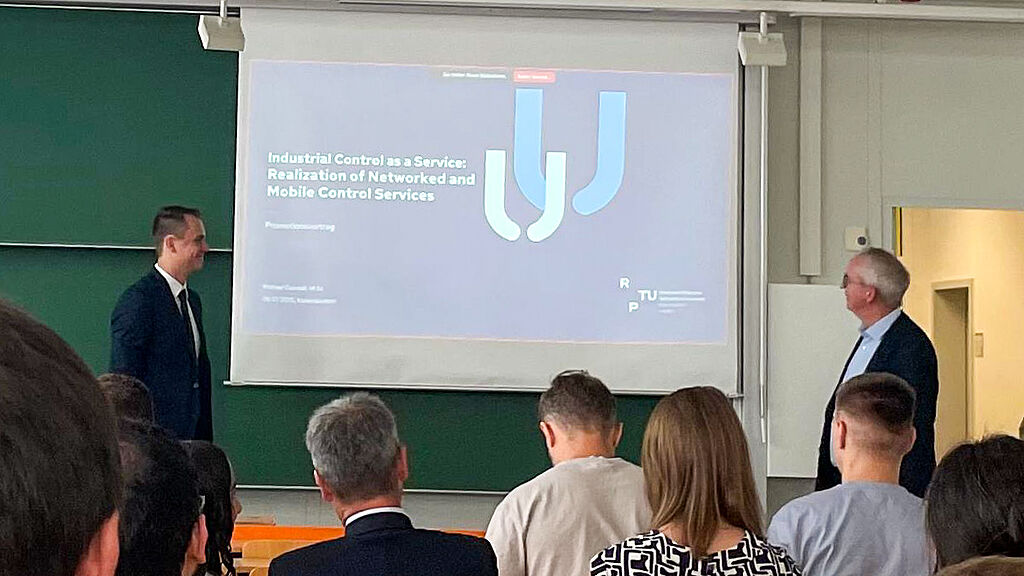
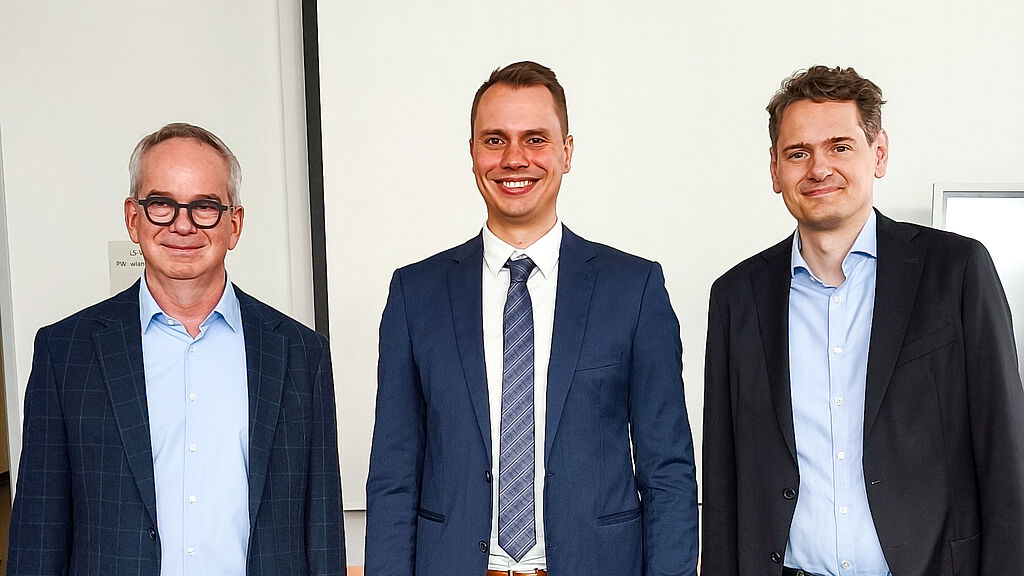
Michael Gundall, an external doctoral candidate in cooperation with the University of Kaiserslautern and the German Research Centre for Artificial Intelligence (DFKI), successfully defended his dissertation on the topic of 'Industrial Control as a Service', achieving a grade of 'very good'. His work presents a cloud-based control approach that opens up new potential for scalability, flexibility, and business models in industry. His supervisors were Prof. Dr. Hans D. Schotten (University of Kaiserslautern) and Prof. Dr. Lukasz Wisniewski (inIT).
Cloud instead of control cabinet
As part of his doctoral studies, Michael Gundall developed an alternative approach to industrial control functionality. Instead of classic programmable logic controllers (PLCs), a software-as-a-service approach is used, which is provided from the cloud. The focus is on creating scalable, mobile and network-compatible control solutions for industry.
Proven partnership
Since 2016, inIT, the University of Kaiserslautern and DFKI have been engaged in a successful research partnership – including the Tacnet 4.0 project, one of the first 5G research projects in Germany.
Joint research agenda continues
Prof. Dr. Lukasz Wisniewski, second supervisor of the thesis and Deputy Director of inIT, congratulates the author on his successful defence and emphasises the potential of the concept developed:
‘The dissertation makes an important contribution to the digital transformation of industrial processes. The cloud approach developed helps to make control technologies more flexible and future-proof. We look forward to continuing our long-standing cooperation with the University of Kaiserslautern and DFKI in future projects.’