


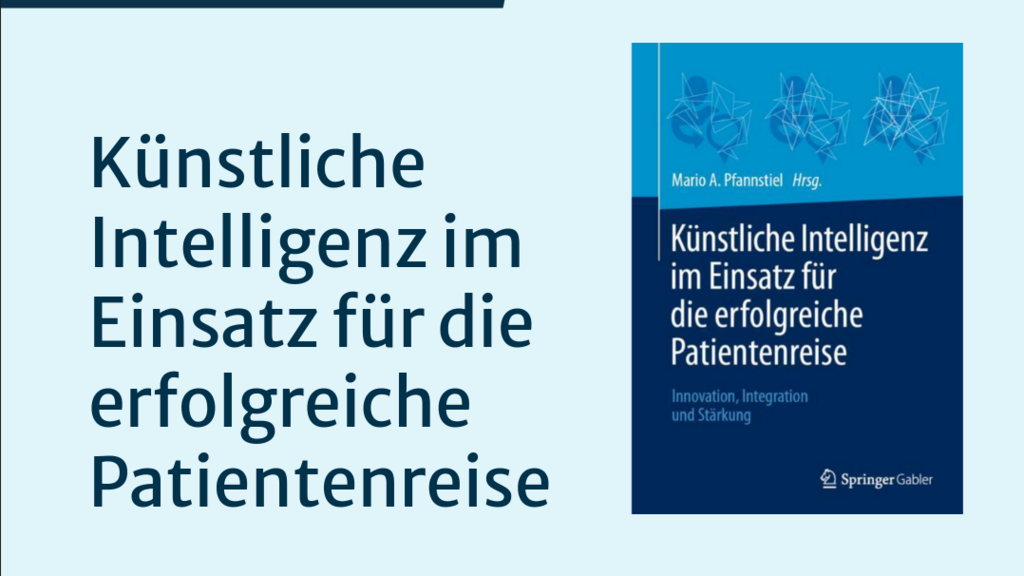
The reference book "Artificial Intelligence in Use for a Successful Patient Journey" (ed. Mario A. Pfannstiel) was recently published by Springer Nature as an eBook and in print. The Discrete Systems working group, led by Prof. Dr. Volker Lohweg, has made a significant contribution to the publication with one chapter.
Artificial Intelligence (AI) in the patient journey
The publication has the subtitle "Innovation, Integration and Strengthening", which, according to the editor, underlines the three central themes of the book. Through the dedicated use of AI, innovations are to be promoted, seamlessly integrated into existing systems and, overall, the patient journey and the healthcare system are to be strengthened. An important approach of the book is to present practical solutions that benefit patients.
Book chapter on the PD-Assist smartphone app
This is where the Discrete Systems working group comes in. It developed the PD-Assist smartphone app as part of the Parkinsonnetz OstwestfalenLippe+ (PNOWL+) as a joint pilot project between the University Clinic for Neurology and Neurogeriatrics, headed by Chief Physician Prof. Dr. Christoph Redecker, University Hospital Ostwestfalen-Lippe, Campus Klinikum Lippe, and inIT.
On the one hand, the smartphone app is intended to be a support tool for people with Parkinson's throughout the course of their illness and, on the other hand, to network interdisciplinary expertise in the OWL region and optimise existing care structures in order to achieve a sustainable improvement in patient care.
Patients are supported in their daily lives with self-care through medication management, therapy planning and personalised assistance systems. But it also takes the pressure off healthcare professionals. Their networking with each other and telemedicine functions enable fast and flexible care, especially in rural areas. In addition, ML-based analyses of movement, speech and sleep data as well as GenAI-based assistance systems open up new perspectives for the long-term analysis of symptom dynamics and the optimisation of therapeutic measures.
Practice-oriented approach
Increasing digitalisation and its impact on patient care, processes and structures offer great opportunities in healthcare in the coming years. The book "Artificial Intelligence in Use for a Successful Patient Journey" clearly combines theoretical perspectives with practical examples from the healthcare industry.
"With the development of the PD-Assist smartphone app, we have shown how AI-supported innovation can improve the situation of patients in a concrete and sustainable way. We are delighted that Frauke Wiegräbe, Dr. Christoph-Alexander Holst and I, together with Prof. Dr. Christoph Redecker, were able to contribute our expertise and research to this beneficial publication," emphasises Prof. Dr. Volker Lohweg.
Mario A. Pfannstiel (ed.)
Artificial Intelligence in Use for a Successful Patient Journey
Innovation, Integration and Strengthening
eBook ISBN 978-3-658-48573-3
Print ISBN 978-3-658-48572-6