

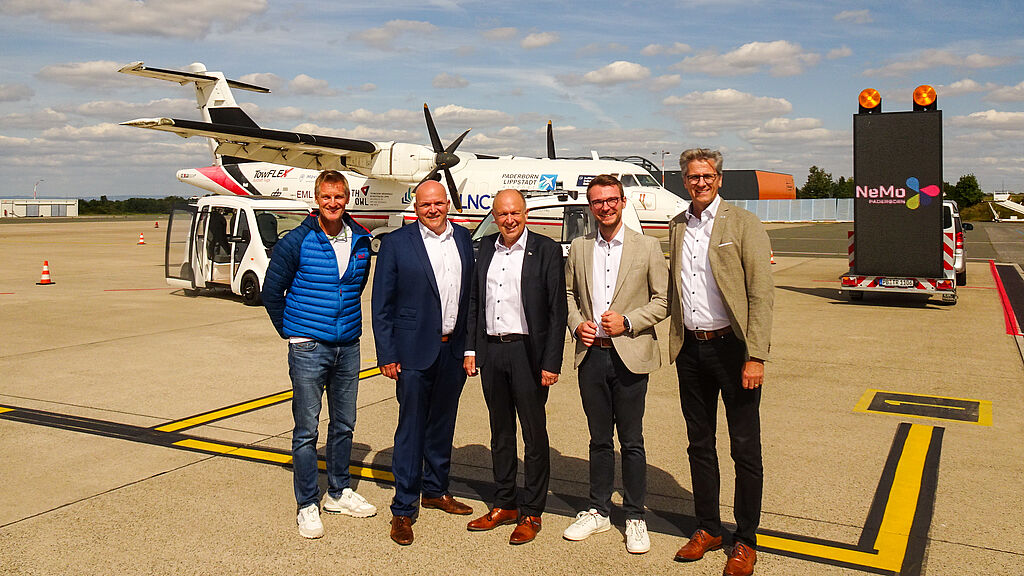
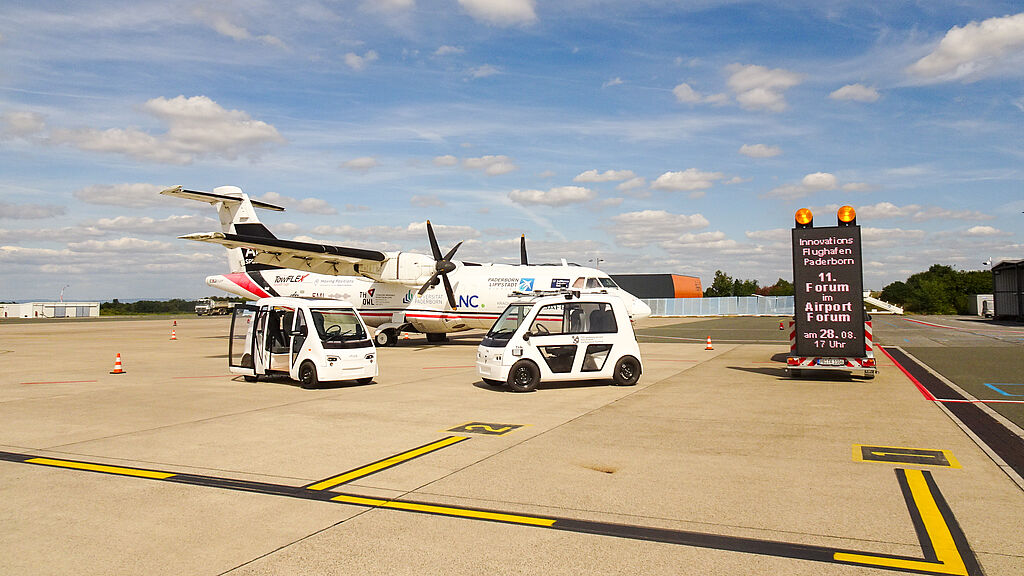
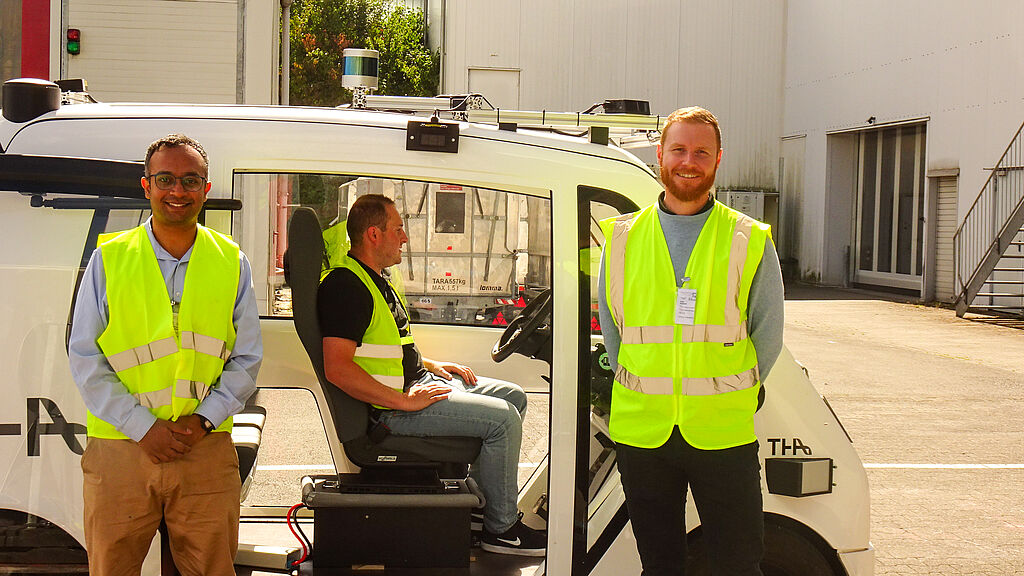
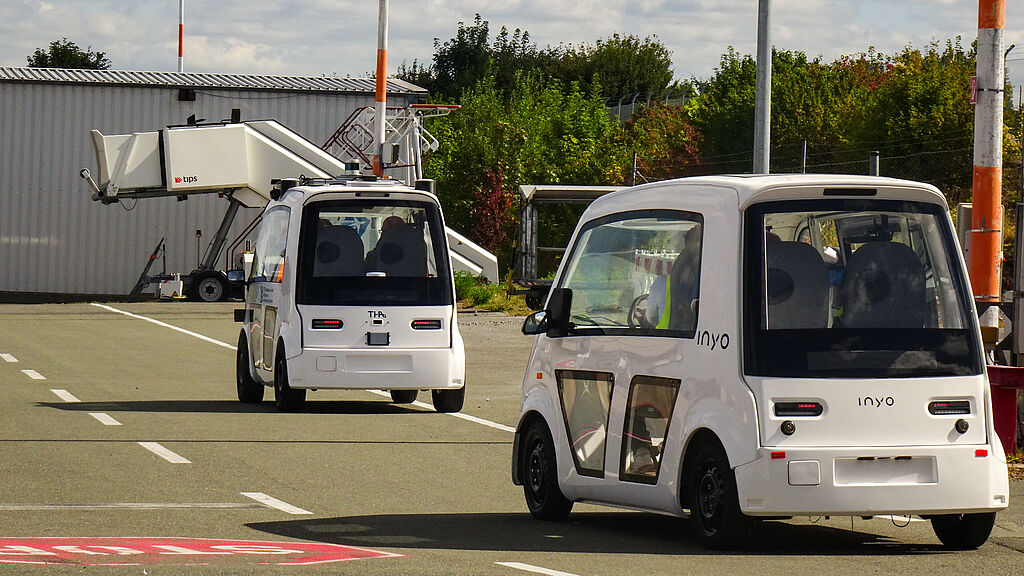
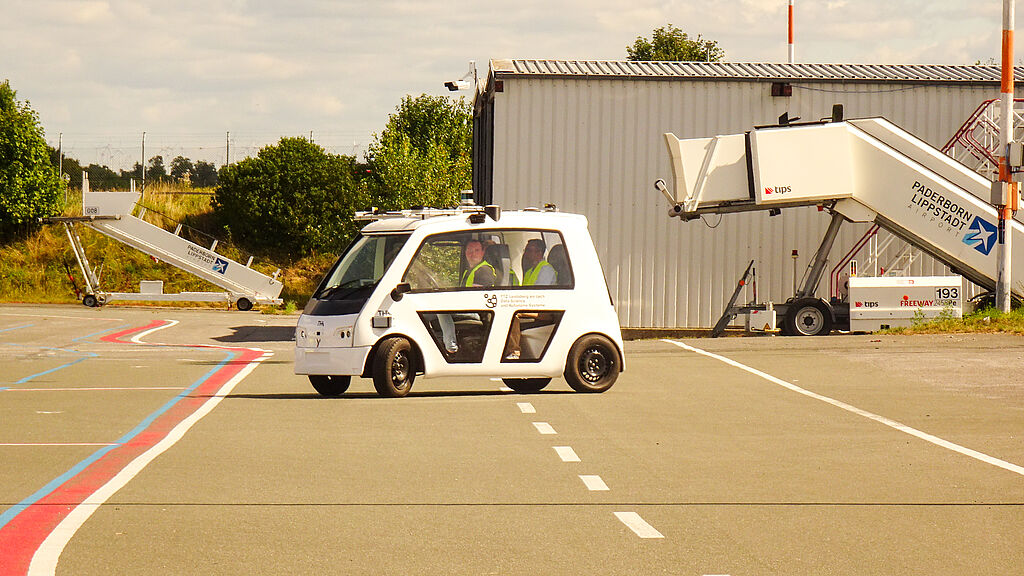
The NeMo.bil project has successfully completed its first automated demonstration drives at Paderborn/Lippstadt Airport, reaching another milestone. Numerous guests from the Germany-wide network of politics, science and the public watched the presentation together with the project partners. The inIT was represented by Prof. Dr. Ulrich Büker and his research associate Ramakrishnan Subramanian. The first automated demonstration drives of an INYO cab took place in a non-public area of Paderborn/Lippstadt Airport. Further automated drives are planned in the Paderborn region in the foreseeable future.
First demonstration drives: trial phase begins
The New Mobility Paderborn (NeMo) initiative and the NeMo.bil project, which it initiated and which is funded by the Federal Ministry for Economic Affairs and Energy (BMWi) with around 18 million euros, have reached the next milestone. The first automated demonstration drives of an INYO cab took place in a non-public area of Paderborn/Lippstadt Airport. Further automated drives are planned in the Paderborn region in the foreseeable future.
Holistic approach to sustainable mobility
The NeMo initiative aims to take a holistic view of mobility and thus create a sustainable mobility ecosystem. The NeMo.bil project aims to develop a solution for individualised public transport and further advance automated driving. Thanks to extensive work in the areas of development, approval and testing, the project is fully on schedule.
"We are very proud of the progress made on our largest project to date, NeMo.bil. We are currently transitioning from the development phase to the testing phase. We would like to thank everyone involved in the project who is working hard on the digital tools and vehicles and preparing the necessary approval processes with great commitment," emphasise NeMo board members Andreas Speith, Christoph Rüther, Michael Heinemann and Simone Probst.
Technical implementation and next steps
Based on small, electrically powered vehicles, NeMo.bil achieves a level of efficiency that is unique in Germany. The cabs pick up passengers directly at their front doors, especially in rural areas, and on longer journeys they form a convoy that is pulled by a larger vehicle (Pro). The partners are currently working on developing the Pro vehicle and the digital ecosystem. At the same time, the cabs are being equipped with modern automation technology and the approval processes for operation with safety drivers in public spaces are being prepared. This means that the system is being rolled out step by step as planned.
inIT develops driving function for automated cabs
inIT is involved in the project to develop the automated driving function for the cabs. The ‘Intelligent Systems’ working group, headed by Prof. Dr. Ulrich Büker, is supporting the development of the control software and sensor technology and defining the safety-related requirements to ensure reliable and safe vehicle operation.
‘With the automated demo drives and the transition from the development to the test phase, we are moving significantly closer to our goal of providing new impetus for sustainable and intelligent mobility. This milestone is a great success for the entire consortium and underlines our close cooperation,’ emphasises Prof. Dr. Ulrich Büker.
Further insights into the project and current developments can be found here: https://nemo-bil.de