PD Assist+: KI-gestützte Assistenz in der Parkinson-Versorgung

 01.10.2025 bis 31.03.2026
AI-supported assistance in Parkinson's care (PD Assist+)
The healthcare system in Germany is facing considerable structural challenges, particularly in nursing care. Demographic change, an increasing number of people with chronic illnesses and a growing dependency on specialist staff are exacerbating existing care issues.
Innovative digital solutions can improve the quality and efficiency of medical and nursing processes, particularly for complex conditions such as Parkinson's disease. With around 400,000 people affected in Germany alone, Parkinson's disease is the second most common neurodegenerative condition after Alzheimer's disease. Caring for those affected is costly and requires continuous, interdisciplinary, coordinated care.
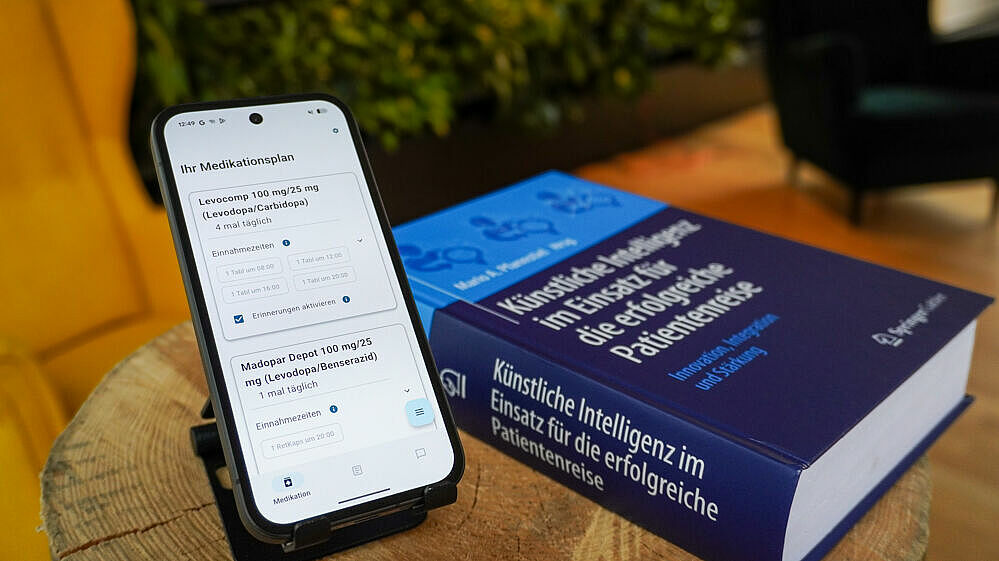
In this context, the use of digital technologies is becoming increasingly important. Smartphones and apps are opening up new possibilities in this area. For example, a Parkinson's app can help patients manage their condition by providing medication plans and enabling self-monitoring, while also assisting carers, therapists and doctors with documentation and evaluation. Sensors in smartphones can also provide information about movement behaviour that can be incorporated into individual therapy planning.
Advances in generative artificial intelligence, particularly through large language models, are enabling further functionalities. For instance, these models can act as a natural language interface for interacting with digital patient records and specialist information.
Objective and implementation of PD Assist+
The PD Assist+ project aims to develop and integrate a digital voice assistant that provides natural access to medical knowledge and digital patient documents. Specifically, the assistant should be able to answer questions about Parkinson's disease, such as those relating to guidelines, therapies or symptoms, in a clear, accurate and context-sensitive manner. The aim is to support both medical professionals and patients in their day-to-day care.
To this end, an existing language model is being expanded and adapted to include Parkinson's-specific expertise. This model is based on a carefully curated dataset that includes content from medical guidelines, specialist literature, and anonymised case studies, among other sources. This targeted fine-tuning produces a model that can correctly process domain-specific content and generate reliable answers.
The next step is to integrate the language model into the existing PD Assist app. This will involve using a retrieval-augmented generation architecture to retrieve general questions about the disease and patient-specific information from the digital archive. This links knowledge and individual data, making it accessible via an intuitive voice interface.
Finally, the new functionality will undergo comprehensive evaluation in a clinical application context. Qualitative and quantitative surveys, such as interviews, user feedback and usability tests, will be used to assess whether the digital assistant reduces the burden on patients and professionals in everyday life, and helps address key challenges in caring for people with Parkinson's disease.
[Photo Credit: Mona Marie Brinkmann | Pageheader]